
 Català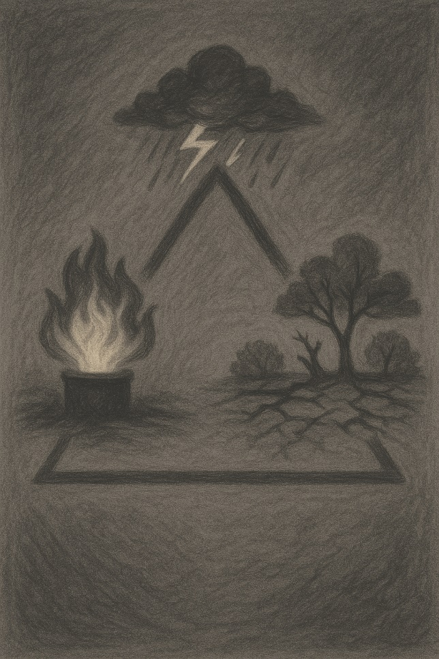
For a long time, global crises have been treated as if they were separate phenomena. Experts have analyzed the energy crisis in one office, climate change in another, and environmental degradation in a third. This compartmentalization may have been useful for understanding some details, but today we know that reality doesn’t work that way. The world is a living, interconnected, and deeply interdependent system. And these three crises not only coexist in time: they reinforce, accelerate, and worsen each other.
The energy risk known as BSE — Blackout Stage Energy — is the real possibility that our global energy system will collapse partially or entirely, not due to a specific catastrophe, but because of the accumulation of structural imbalances: depletion of affordable fossil resources, inefficiencies in the energy transition, dependence on vulnerable centralized networks, and a demand that grows without limits on a planet that does have limits. All of this forms a fragility that has been too long ignored and that, once it becomes visible, may be too late.
But this energy crisis does not exist in a vacuum. The same extractive and expansive model that has supported energy abundance for decades is also the one that has caused a sustained increase in greenhouse gas emissions. These emissions have destabilized the global climate: they increase the planet’s average temperature, alter rainfall cycles, make droughts, floods, and storms more frequent and extreme, and force millions of people to adapt, relocate, or survive as they can. Climate change is no longer a hypothesis for the future: it is a condition of the present.
Meanwhile, as the third vertex of this triangle, environmental degradation continues to advance. Biodiversity is being lost at a rate a hundred times faster than normal. Groundwater is being depleted, soils are deteriorating, and oceans — loaded with microplastics and industrial waste — are losing their most delicate balances. This environmental crisis doesn’t always make headlines, but it is persistent, silent, and devastating. Without a functional environment, there is no food, no health, no vital foundation.
This is the reality: we are not facing three separate crises, but a single global crisis unit that manifests in three interrelated dimensions. It is a mistake to treat them separately, because one drives the other. When energy consumption increases to deal with the effects of climate change — air conditioning, desalination plants, relocation of populations, reconstruction of infrastructure — emissions increase too. When new energy sources are sought at any cost, serious environmental concessions are often made: deforestation for bioenergy, mining for batteries, agricultural land being taken for industrial infrastructure. And when the environment is degraded, the natural capacity to absorb CO₂ and regulate the climate is reduced, further accelerating the climate emergency and worsening energy dependency. Everything is connected. Everything is part of a negatively reinforcing cycle.
Understanding this interdependence is key to imagining a realistic and effective way out. And this is where Sunthereum makes sense — not as a simple energy transition proposal, but as an architecture designed to address the three roots of the crisis at once. Sunthereum doesn’t promise miracles. But it does offer a new, systematic, and coherent energy structure aligned with the planet’s limits. An architecture based on solar, distributed, and decentralized generation. An infrastructure designed to reduce fossil fuel dependence, minimize territorial impact, and promote community resilience in the face of global disruptions.
Unlike centralized models, which often concentrate power and vulnerability, Sunthereum promotes distributed control, energy democratization, and modular adaptation according to the conditions of each territory. This reduces the need for large intrusive infrastructure, minimizes environmental costs, and at the same time favors an integration with the environment that is not based on exploitation but on coexistence.
But what makes this approach especially valuable is that it does not stop at engineering. Sunthereum also puts forward a cultural shift: a new relationship with energy, with nature, and with collective responsibility. An invitation to rethink our way of inhabiting the world. If we continue acting as if each crisis were an independent problem, we will keep applying patches that merely displace the damage from one place to another. But if we understand that the crisis is systemic, then the solution must also be systemic. And this is what Sunthereum proposes: not just to produce differently, but to live differently.
Humanity is not doomed. But it has reached the limit of what it can sustain without changing. And that change will not come on its own. It will require determination, vision, and courage. Sunthereum is only one proposal. But it could be the beginning of a new narrative: that of a civilization which, instead of blindly resisting collapse, chooses to transform it into an opportunity for rebirth.