
 Català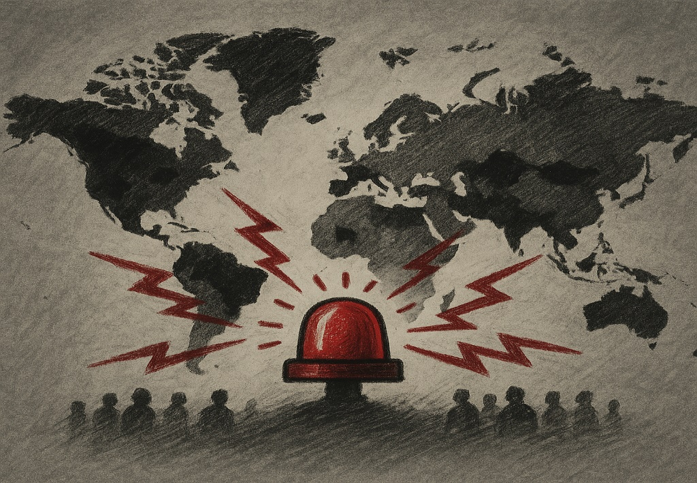
The silence before collapse is not mute. It is full of tremors, sparks, warnings that many prefer not to hear. The world will not suddenly run out of energy as if someone turned off a universal switch. What we are already experiencing today are the first tremors of a high-magnitude earthquake: power outages spreading like oil stains over saturated grids, intermittent supply in areas that until recently seemed secure, geopolitical tensions linked to pipelines, minerals, and strategic reserves. The signs are there. It only takes the will to read them.
Energy failure episodes, often classified as technical errors, cyberattacks, or isolated crises, hide a more disturbing truth: they are the visible expression of a global energy architecture that is beginning to shake. Our extreme dependence on a continuous, stable, and predictable flow of energy has created a systemic vulnerability. When this flow breaks — due to supply deficit, logistical collapse, or lack of resilient infrastructure — everything that sustains modern life enters into crisis: hospitals, transport, telecommunications, food supply, drinking water. It is at this point that BSE ceases to be a hypothesis and materializes as reality.
You don’t have to look far. On April 28, 2025, a massive blackout shook Spain, Portugal, and parts of France, leaving tens of millions of citizens without electricity. In a matter of seconds, Spain lost 15 gigawatts of power, equivalent to 60% of its national demand. This event paralyzed trains, airports, hospitals, mobile networks, and ATMs, severely affecting daily life and essential services. Officially classified as an “electrical supply incident of indeterminate origin,” it had all the features of a micro-BSE: sudden collapse of high-voltage lines, automatic disconnection of substations, collapse of communication systems, loss of running water in multiple municipalities, and disruption of medical services. For hours, a significant portion of the population experienced, live, the extreme fragility of a system we believed to be robust. And if this was just a taste of what may come, the question is not whether we are prepared — but whether we want to be.
This episode is not an isolated case. On June 19, 2024, Ecuador suffered a nationwide blackout due to the failure of a transmission line. On June 21 of the same year, a large part of the Balkans, including Montenegro, Croatia, and Albania, lost power during an extreme heatwave. In August, Venezuela experienced a nationwide blackout that the government attributed to sabotage.
These events, geographically dispersed but similar in nature, indicate a worrying trend: global energy infrastructure is under increasing pressure, and failures are becoming more frequent and severe. The combination of factors such as climate change, aging infrastructure, the energy transition to renewable sources without adequate planning, and geopolitical tensions contributes to this vulnerability.
These signals speak not only of technical inefficiency. They speak of a deep imbalance: the energy model has been stretched to the limit but has not changed its core logic. Everything has been connected to a network that tolerates no errors, distribution has been obsessively centralized, and safety margins have been sacrificed for the promise of economic efficiency that is no longer real. And now, when the consequences arrive, they are disguised as unexpected.
What this chapter proposes is not to sound the alarm out of fear, but out of responsibility. The future will not come with an explosion, but with a series of progressive, discontinuous, but devastating disruptions. And while we wait for “the great collapse,” we may fail to see that we are already immersed in it. Every blackout, every energy tension, every conflict over resource control is part of the same process. BSE is not a door that will suddenly open, but a window that is slowly closing.
The great paradox is that humanity is not blind. It has the data, the reports, the predictions. What it lacks is not information, but the courage to act. And this is where Sunthereum appears as a response: not as another utopia, but as a structural proposal capable of anticipating events, absorbing tensions, and building alternatives before collapse becomes irreversible.
But this chapter does not wish to be only diagnostic. It wants to be evidence. It wants to show that we are no longer talking about imaginary futures, but concrete presents. And it wants to invite recognition that the only way to face a global crisis is to accept it, understand it, and act from awareness and collective intelligence. The alert has been sounded. Now we must decide whether we want to hear it.