
 Català
The relativity between means and ends as an instrument of power
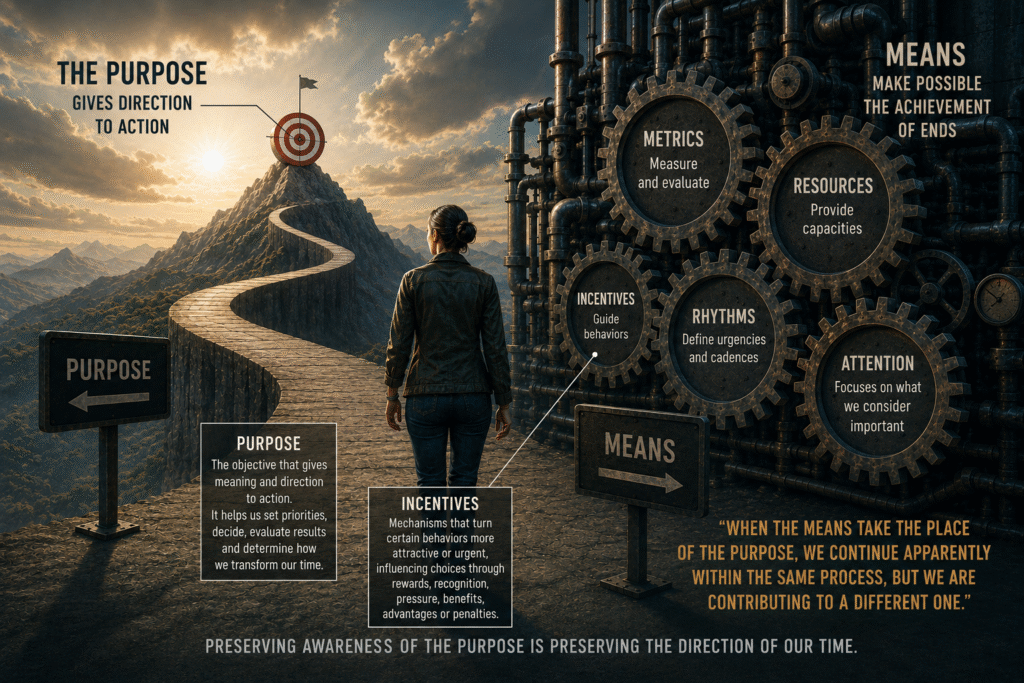
A large part of our daily activity is oriented by ends. We make decisions, devote time, mobilize resources, acquire knowledge and use instruments because we want to get somewhere. The end gives direction to action and allows us to assess whether what we do brings us closer to it. Between the starting point and the objective appear the means: everything that we place at the service of an end and that allows us to advance towards it.
This relationship, apparently simple, contains a characteristic that often goes unnoticed: means and end are not permanent conditions of the elements involved in our activity. What in a given situation constitutes an end may act as a means in another, and what we initially use as a means may progressively acquire a different function. The condition of means or end therefore arises from the relationship that each element maintains with what we want to achieve.
This relativity acquires special importance when the relationship between means and ends changes while we continue acting. We may maintain the same activities, use the same instruments and even preserve the conviction that we are advancing in the same direction, while the end that originally gave meaning to our action gradually loses centrality. Understanding how this transformation takes place allows us to observe a particularly subtle dimension of power: the capacity to influence our ends by acting upon the means we use to achieve them.
· Ends give direction to human action
Human action acquires meaning when it is oriented towards an end. We understand here by end the objective that gives meaning and direction to an action. From the most elementary decisions to the projects that occupy years of our lives, we act by projecting a situation that we want to achieve, preserve or transform. This projection establishes a direction and organizes our action according to what we want to achieve. The end is, in this sense, prior to the conscious action we undertake to reach it.
Defining an end means establishing a point of reference from which we can order decisions. It allows us to determine priorities, distribute resources, assume certain costs, renounce alternatives and decide what we devote our time to. The same action may acquire different meanings according to the end it serves, because it is this end that allows us to interpret its function. The coherence of action depends, to a large extent, on the correspondence between what we do and what we want to achieve.
The end also provides a criterion for evaluation. It allows us to ask ourselves whether we are advancing in the intended direction and whether the result we are building corresponds to the objective that guides our action. An activity may be intense, complex and efficient; it is its correspondence with the end that determines the value of this efficiency. Efficiency describes the way in which we act; the end determines where we direct this capacity to act.
There is, moreover, a direct relationship between end and time. Each end demands a part of our present time in order to build a certain future reality. When we decide to pursue an objective, we also establish, explicitly or implicitly, a priority regarding the use of our time. Devoting time to an end means converting a limited part of our existence into action oriented towards it. Ends, in addition to ordering what we do, thus contribute to determining what we turn our time into.
A recognized and present end maintains direction, offers criteria for reviewing decisions and allows us to assess the correspondence between the effort made and the result pursued. Around it are organized the actions, resources and time necessary to advance.
Between this will and its realization lie the instruments that make it possible to transform an intention into action and action into result. These are the means, the second element of the relationship we are analysing.
· Means make ends possible
An end defines what we want to achieve, but its realization requires the capacity for action. Between the starting situation and the one we want to build there is a distance that we cover through decisions, knowledge, resources, instruments and actions. Everything that we place at the service of this journey acquires the function of a means.
The condition of a means arises from the function that an element performs with respect to an end. A resource, knowledge, a technology, an institution or a certain action become means when we use them to achieve something. Their nature may be very diverse; what identifies them as means is the position they occupy in the relationship between the subject who acts and the end that guides their action.
This relationship develops within a process, understood here in its most elementary sense: the ordered set of actions and transformations that connect a starting situation with an end. The process provides the space in which subject, end and means relate to one another. It interests us insofar as it makes this relationship visible; our object of analysis continues to be the connection between means and ends.
The end provides the criterion with which we select and assess the means. We choose an instrument because it is suitable for achieving what we pursue; we adopt a procedure because it allows us to advance; we acquire knowledge because it expands our capacity to act. The usefulness of the means is thus linked to its contribution to the end. This connection establishes a functional hierarchy: the end guides and the means serves this orientation.
The same hierarchy allows us to review the means during the development of the action. A means retains its usefulness while it adequately contributes to the end and may be modified or replaced when another option allows it to be served better. Placing the end at the centre allows us to adapt the instruments while preserving direction.
But the condition of means does not reside permanently in the element we use. It arises from the function that this element performs with respect to a particular end. When this relationship changes, its function may also change.
We thus arrive at the central point upon which this article is built: the condition of means and the condition of end are relative to the relationship in which each of these elements participates.
· The relativity between means and ends
The distinction between means and end seems, at first approximation, sufficiently clear. The end indicates what we want to achieve; the means contributes to making it possible. This distinction remains valid while we observe a specific relationship, but acquires a different dimension when we consider that the same element may participate simultaneously or successively in different relationships.
No element is, by nature, a means or an end. This condition depends on the function it performs in relation to a particular end, within a specific context and process.
Means and end are functional categories. They define the position that an element occupies within a particular relationship, and this position acquires meaning with respect to what the subject intends to achieve. When the end, the subject, the context or the process changes, the function we attribute to the same element may also change.
What constitutes an end in a particular relationship may act as a means in another. Achieving an objective may provide the conditions necessary to pursue a new one, so that an achieved end becomes a means for a subsequent end. The reverse movement also occurs: an element initially incorporated for its instrumental usefulness may progressively acquire value of its own and turn its acquisition, preservation, improvement or expansion into an objective.
Relativity also appears when several subjects participate in the same reality. An element that constitutes an end for one subject may, at the same time, be a means for another. Both may share actions, resources or interests and nevertheless attribute different functions to what relates them. Coincidence in action does not imply coincidence in the end.
Asking whether something is a means or an end is therefore insufficient if we do not specify for whom, for what, in what context and within what relationship. The answer may be different for each subject and may also vary over time.
This temporal dimension is especially important. An achieved end may open another; a means may acquire new functions; a transformation of the context may modify priorities; and subjects may redefine what they want to achieve. The relativity between means and ends therefore also has a temporal and dynamic dimension.
This possibility of change expands the human capacity to adapt action to new circumstances. We can review objectives, replace instruments, incorporate new capacities and construct successive ends. The functional relativity between means and ends provides flexibility to our action.
Precisely because of this flexibility, it is essential to keep visible the function that each element performs. When we know what the end is, we can assess the means in relation to it. When we consciously decide to transform an end, we can reorganize them according to the new direction.
The question acquires a different nature when this relationship changes without the subject clearly identifying the transformation. The same element remains present, activities may maintain an appearance of continuity and, nevertheless, the function it performed within the relationship has begun to change.
It is in this mutation of the relationship that the phenomenon we are interested in understanding appears.
· The mutation of the relationship between means and ends
The relationship between means and ends is initially built upon a clear functional hierarchy: the end guides action and the means are placed at its service. But, like every relationship that develops over time, this one too may change.
The mutation may begin without formally modifying the end. A means that initially occupied an instrumental position may progressively require more attention, knowledge, resources or time. It may acquire complexity, generate structures of its own, incorporate new interests and establish specific criteria for assessing its functioning. Its presence grows and, with it, its capacity to condition the action as a whole.
This growth may form part of the normal development of an activity. Means are improved and capacities increase. A more powerful means may expand the possibilities of achieving an end and allow us to reach it more efficiently. Its expansion then preserves the function that justified its existence: increasing our capacity to act in the chosen direction.
The essential question lies in the relationship that this expansion maintains with the end. As long as the development of the means continues to be governed by what we want to achieve, the functional hierarchy is preserved. The end provides the criterion with which we decide how far it is appropriate to improve it, how many resources we allocate to it, how much time we devote to it and what value we attribute to the results it generates.
The mutation acquires another dimension when the means itself begins to generate its own criteria of evaluation. Its availability, its growth, its sophistication, its efficiency or its permanence may progressively become indicators of success. What we initially valued for its contribution to an end also begins to be valued for its own characteristics. The centre of gravity of the relationship thus begins to shift.
This shift particularly affects attention and time. When a growing proportion of activity is concentrated on developing, managing, preserving, measuring or improving the means, these begin to influence the organization of the action they were initially meant to serve.
The transformation may occur gradually. Each decision considered in isolation may maintain a reasonable relationship with the original end. It is the accumulation of these decisions that modifies the proportion between the elements. Everyday continuity makes it easier for each new situation to be assumed as a natural extension of the previous one, while the distance from the starting point increases.
This gradualness allows the subject to preserve the perception that they continue developing the same activity and pursuing the same end. The names may remain, the structures may continue functioning and many actions may continue to be the same. The transformation takes place in the effective function that each of the elements performs.
Effective priorities allow us to observe this mutation. What organizes decisions, concentrates resources, absorbs time and determines the criteria of success reveals the real hierarchy existing at each moment.
Once a certain threshold has been reached, the means no longer merely facilitates action: it begins to guide it. It no longer merely receives resources because it serves an end: its own continuity, expansion or improvement begin to justify the allocation of new resources.
The initial hierarchy is changing. The means begins to become an end.
· When the means takes the place of the end
The mutation reaches a decisive point when the means ceases to occupy a subordinate position and begins to organize a growing part of the action. The original end may remain present and recognized, but the effective hierarchy has begun to reverse. What had been incorporated to make it possible to reach an objective acquires the capacity to determine what we do, how we distribute resources, what we devote time to and according to which criteria we assess results.
This change introduces a fundamental distinction between the declared end and the effective end. The former expresses what we state that we want to achieve. The latter manifests itself in the decisions we actually make, in the priorities we establish and in the concrete distribution of time, attention and resources.
What determines priorities, guides decisions and establishes the criteria by which we measure success performs the function of effective end. For this reason, the transformation of a means into an end requires no formal declaration. It occurs when the functioning, preservation, growth or improvement of the means come to justify the activity by themselves.
The means then ceases to be valued according to the end it was meant to serve and begins to generate its own end.
This is the breaking point of the initial hierarchy. The question “to what extent does this help us achieve our end?” gradually loses centrality in favour of criteria generated by the means itself. Its capacity to serve ceases to constitute the principal measure of its value; its own existence begins to justify it.
Means, moreover, generate activity. They need to be managed, maintained, improved, measured and adapted. This activity is real, requires effort and produces visible results. Precisely this capacity to generate activity facilitates the perception of continuity: we continue doing things, making decisions, solving problems and obtaining results.
Activity, however, acquires its meaning in relation to the direction it serves. Doing more, doing it faster or more efficiently increases our capacity to act; it is the end that determines the value of this capacity. When the means progressively assumes this ordering function, we may extraordinarily increase the efficiency of an activity while its correspondence with the objective that initially justified it decreases.
It is here that the dilution of the end appears. Dilution allows an end to continue to exist while progressively losing its capacity to order action. An end may be preserved for a long time in language, principles, rules or collective memory while losing its capacity to determine everyday decisions. Its symbolic presence may even contribute to maintaining a sense of continuity.
Time allows us to observe this transformation with particular clarity. What we devote our time to reveals what actually occupies the centre of action. When a growing part of the available time is devoted to sustaining, administering or expanding the means, this distribution eventually configures a new reality. The time that had been allocated to building an end begins to feed the instrumental structure created to achieve it.
We may thus come to continue working intensely for an end that retains its entire presence in our discourse while our effective activity progressively contributes to consolidating another.
This possibility acquires a new dimension when several subjects intervene. What constitutes a means for us may represent an end for another, and what we consider our end may form part of the means that another subject uses to achieve theirs.
It is in this overlapping of ends, means and subjects that the possibility appears that the transformation may be favoured, guided or exploited by those who possess the capacity to intervene in the conditions under which we develop our action.
This is where power enters.
· The intervention of power
Power manifests itself in the capacity to influence the conditions under which other subjects make decisions, distribute resources, establish priorities and devote their time. This capacity may also act upon the architecture that relates ends to the means used to achieve them.
Each subject acts from their own ends within an environment shared with other subjects who also pursue theirs. These ends may coincide, complement one another, compete or develop on different planes. The same reality may occupy different functions for each of them.
Power acquires a particular position when it possesses the capacity to configure the means that other subjects need or use. Whoever can define the conditions of access to a resource, establish the criteria by which an activity is assessed, determine the incentives associated with certain behaviours, set rhythms or concentrate attention possesses an effective capacity to intervene in the relationship between means and ends.
This intervention may occur while the original end is formally maintained. Action upon the means modifies the conditions under which that end is pursued. When incentives, priorities, evaluation criteria, rhythms or available resources change, the way in which the subject distributes their activity also changes.
The mechanism acquires strength because it works upon elements that form a legitimate part of action. Means are necessary. Procedures provide order. Incentives guide behaviours. Criteria make evaluation possible. Structures facilitate continuity. Rhythms coordinate activities. The decisive question is what relationship these elements maintain with the end and who possesses the capacity to define them.
When this capacity is concentrated in a subject different from the one pursuing the end, a significant asymmetry appears. One subject preserves their end while another may intervene upon part of the means they need to pursue it. Functional relativity allows these same means simultaneously to serve different ends: that of the subject who uses them and that of whoever configures, provides or governs them.
This asymmetry allows us to understand a subtle form of the exercise of power. An action may also be guided by configuring the conditions that make some options more accessible, valuable, recognized, urgent or costly than others. The subject continues deciding and acting, but does so within an architecture of possibilities that influences the effective distribution of their energy.
Incentives have an especially powerful function here. What is rewarded tends to gain centrality; what is measured tends to concentrate attention; what provides recognition tends to guide behaviours; what is perceived as urgent tends to occupy immediate time. Maintained over time, these elements may modify the hierarchy between the means and the end.
Time once again occupies a central position. Power that affects what others devote their time to intervenes upon a finite resource. Guiding attention, establishing urgencies, multiplying requirements or defining rhythms means participating in the distribution of other people’s time. Maintained over time, this distribution contributes to configuring their effective priorities.
Intervention upon the means may thus turn the subject’s own activity into part of the mechanism that transforms their effective end. The subject contributes their time, knowledge, energy and decisions, while the configuration within which they act may progressively guide these resources towards a different end.
We thus arrive at one of the most important consequences of the relativity between means and ends:
Power can influence an end without having to act directly against it: it can intervene upon the means, modify the hierarchy that relates them and favour another end progressively acquiring the capacity to order action.
The depth of the mechanism lies in continuity. The subject may preserve the perception that they are following the same path because many of their actions remain recognizable and the original end remains present as a reference. The determining question, however, is which end effectively governs the activity.
When the answer ceases to coincide with the one that had initially given meaning to the action, we enter the silent substitution of the end.
· The silent substitution of the end
The relationship between means and ends reaches its deepest transformation when the end that effectively governs the action ceases to coincide with the one that the subject continues to recognize as their own. The original end may retain its name and continue to form part of the discourse. Meanwhile, another end has progressively acquired the capacity to order decisions, distribute resources and determine the use of time.
The declared end expresses what the subject identifies as the meaning of their action. The effective end manifests itself in what this action actually contributes to building. The former belongs to the realm of consciousness, intention and narrative; the latter is revealed in the accumulated direction of decisions and in the results they produce.
The separation between the two may occur gradually. Each modification of the means, each new criterion, each incentive and each redistribution of time introduces a variation. The succession of these variations builds a new hierarchy until the sum of the adjustments configures a different direction.
Apparent continuity performs an essential function here. We recognize the processes in which we participate through their names, structures, routines, symbols and activities. When these elements remain, we have numerous indications of continuity. We may continue doing what we did, occupying the same position and using the same instruments while the relationship that gave meaning to the whole has changed.
For this reason, substitution may be silent. Action persists and provides the subject with the perception of advancing. The means function, the structures produce results and time continues to be occupied. The transformation lies in the direction that integrates these activities and in the end to which they ultimately contribute.
When this separation becomes consolidated, the means has acquired a new function within the relationship. It has developed or serves an end of its own that organizes the activity around it. The relativity between means and ends has allowed what occupied a particular position within the relationship now to occupy another.
This transformation also modifies the meaning of the process. A process acquires identity through the direction that connects the actions that form it with an end. If this end changes effectively, the nature of the whole also changes, even if an important part of its components remains recognizable.
We apparently continue within the same process, but we are contributing to a different process.
The same activity may acquire a different meaning when it becomes integrated into an architecture oriented towards another end. The capacity of power to guide means, incentives, priorities, rhythms and time makes it possible to participate in this transformation while maintaining the declared end as a reference as another progressively performs the ordering function.
The subject may continue contributing will, energy and time convinced that these resources serve the end they recognize as their own, while the effective configuration of their activity also—or mainly—guides them towards a different end. The strength of the mechanism lies in this active participation: the subject continues to be an actor, but the accumulated direction of their action has been reconfigured.
Understanding this reality allows us to observe the relationship between power and freedom also from the capacity to preserve awareness of the direction of one’s own action. Recognizing what at each moment occupies the position of means and what effectively performs the function of end allows us consciously to assess the direction we build with our decisions.
It is from this awareness that we can preserve the direction of our own action.
· Preserving awareness of the end
Understanding the relativity between means and ends provides us with a tool for observing more precisely the direction of our action. Knowing that no element permanently occupies one of these two positions allows us to review the relationship we maintain with what we do, with the instruments we use and with the objectives to which we devote our time.
Awareness of the end acts as a point of reference. It allows us to situate each decision within a broader direction and assess the means according to their contribution to what we want to achieve. Ends may change, and this transformation forms part of our capacity to choose new directions. When the change is conscious, we can reorganize the means, redistribute resources and orient time according to the new end.
Preserving awareness of the end means keeping active the capacity to review the correspondence between what we want and what we do: what we want to achieve, what reality we are building through our activity and what relationship the means we use maintain with this direction.
This review acquires special importance in a context of abundance of means. We possess a growing capacity to act, communicate, produce, measure, calculate, automate and intervene upon reality. Each new capacity expands the space of our possibilities and demands a decision regarding the end to which we want to apply it. The more powerful the means, the more important clarity about the direction that governs them becomes.
Time offers an especially revealing criterion. Its distribution shows which activities effectively occupy our lives and allows us to contrast them with the ends we recognize as our own. Asking ourselves what we devote time to is also asking ourselves what reality we contribute to building.
This perspective likewise broadens our awareness of power. We participate in shared structures, use means created or governed by others and act within systems of incentives, priorities and rhythms. Understanding how these elements intervene in the relationship between means and ends helps us identify what effective direction our actions construct.
Awareness of the end thus becomes a form of awareness of power. It allows us to distinguish between the end we recognize as our own and the other ends to which our activity may contribute, and consciously decide what relationship we want to maintain with the means that connect them.
The capacity to redefine our objectives forms part of human freedom. A new end, consciously assumed, expresses a new decision and allows us to orient our means and our time towards it.
Understanding the relativity between means and ends therefore brings us back to an elementary question that should be kept alive:
What end really governs what we are doing?
The answer lies in the decisions we make, in the priorities we establish, in the resources we distribute and, above all, in the time we devote to them. It is there that the end ceases to be a declaration and becomes effective direction.
Preserving this awareness means retaining the capacity to recognize where we orient our action and which ends we contribute to building through it.
Because means expand our capacity to act. Awareness of the end allows us to decide where.
Next: Humanita Destruens