
 Català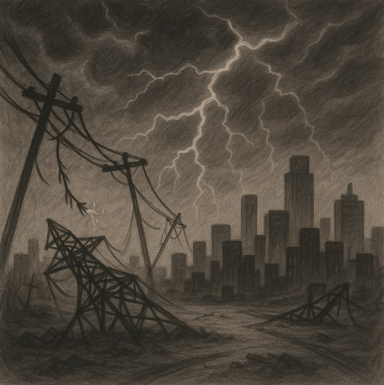
There are concepts that, once pronounced, strike a deep chord in thought. Blackout Stage Energy, or simply BSE, is one of them. It is not just any technical term, nor an acronym destined to dissolve among technological trends. It is, on the contrary, a concept that appeals directly to the heart of our survival as a technologized species. BSE designates a critical — perhaps terminal — phase of the global energy system, a scenario in which humanity, after having built its world upon a foundation of fossil fuels, discovers that this foundation is beginning to sink… without having built another to support the weight of its own progress.
To fully understand the nature of BSE, we must go back. Let us imagine a temporal scale where we place the formation of fossil fuels more than 400 million years ago. During this immense geological period, nature has been accumulating — drop by drop, layer by layer — the carbon of extinct life, converting it into deposits of oil, coal and natural gas. This reserve, hidden underground, has been the energy cushion that has allowed contemporary civilization to develop, grow, expand. But, paradoxically, this prehistoric gift is being devoured with a voracity that gives it a life expectancy of only 100 to 150 years, according to the most realistic estimates. What is even more disturbing is that we have only been consuming it intensively for about 200 years, since the first industrial revolution, when the steam engine began to transform the world. That is: a process of hundreds of millions of years could come to an end in an insignificant fraction of human history, and even more so, in a ridiculous fraction of the time since we started depending on it.
BSE appears precisely in this rupture of temporal rhythms. It is the abyss that opens between the rapid exhaustion of resources and the inability to generate a systemic response in time. A world that lives hyperconnected, digitized, robotized and electrified is heading towards a future where the energy to make it work may become intermittent, insufficient or, in the worst case, nonexistent. The name blackout, in this context, is not just a metaphor for darkness: it is literal. A global energy blackout could imply the collapse of health systems, the paralysis of logistics, the shutdown of critical infrastructures, and the breakdown of the social and institutional fabric on a global scale.
But even more important than the what, is the how and the why. Why are we reaching this point? How is it that, even with the data in hand, we continue to act with the same suicidal inertia? These questions point not only to collective negligence, but to a culture of immediacy, of immediate profit and of willful ignorance, which has turned the energy danger into a taboo, into an uncomfortable truth that no one wants to look at directly.
Awareness of BSE implies recognizing that the current energy system is structurally unviable in the long term. And not because of a punctual price crisis, nor because of a war or a logistical blockade. But because we have settled into a fiction: that of believing we can grow indefinitely on a finite planet, with finite resources and with a model that only knows how to burn and consume.
From this point of understanding — from the diagnosis without euphemisms — we can begin to think about solutions. But to get there, we must look at BSE for what it really is: a civilizational warning. An urgent call to break with the inherited model and to build a new energy architecture that is not just an ecological mirage, but a functional and sustainable structure for centuries.
And this is where the Sunthereum proposal comes into play. But before getting there, we must rigorously dismantle the deep causes that have brought us to this scenario. Because only from the truth — even if it is uncomfortable — can truly lasting responses be built.