
 Català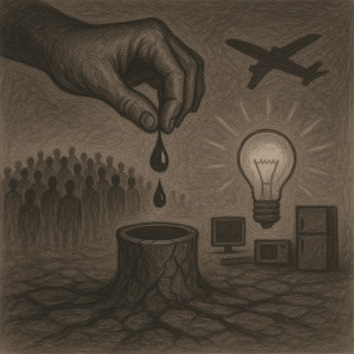
Reduction of Fossil Fuel Reserves and Availability
The first structural cause of the energy collapse risk we call BSE is, undoubtedly, the most obvious and at the same time the most silenced: the physical exhaustion of fossil fuel reserves. This is neither an apocalyptic prediction nor a futuristic speculation, but a perfectly documented geological and logistical fact. Planet Earth contains a finite quantity of fossilized organic matter, and this quantity has already been partially extracted, refined, and burned. What remains underground, in the form of oil, coal, and gas, will never increase again. It can only diminish.
What might seem so elementary—the acknowledgment of a physical limit—is, paradoxically, an uncomfortable truth that official discourses and economic policies insist on ignoring. The world continues functioning as if these resources were inexhaustible. As if drilling deeper or inventing new extraction techniques were enough to maintain the illusion of abundance. But this illusion has an expiration date.
The data is clear. Major conventional oil-producing regions—such as Saudi Arabia, Russia, the United States, or Venezuela—surpassed their peak oil years ago, that is, the maximum production point. From here onwards, what follows is decline, not expansion. New discoveries of oil fields are increasingly rare, smaller, and more difficult to exploit. Even worse: remaining reserves often require much costlier investments and technologies, with diminishing energy returns. This is known as EROEI (Energy Returned on Energy Invested), a fundamental indicator showing whether it is worth—or not—extracting a resource. When for each unit of energy invested, only one or two are returned, the system begins to collapse.
This scenario is not very different for natural gas and coal. Conventional gas has peaked in many regions worldwide, and although hydraulic fracturing gas (fracking) has been promoted, it presents extremely high environmental risks and a very short lifespan. As for coal, even though reserves are larger, its quality has drastically diminished, and associated emissions make it increasingly less viable in the context of the climate crisis.
But there is an even more worrying factor: the deliberate, or even orchestrated, ignorance of this reality. Much of the official data on reserves is inflated by political and economic interests. Producing states tend to exaggerate their resources to attract investment, maintain geopolitical influence, or simply avoid panic. Thus, a collective fiction, an apparent normality, is constructed while the clock ticks.
The truth is that we find ourselves in a twilight phase of oil, and with it, of the entire energy system depending on it. Every liter burned today is a liter we will not have tomorrow. And this tomorrow, contrary to what we would like to believe, is not that distant.
Therefore, understanding this reduction in reserves is not merely a geological issue: it is an act of collective maturity. It is accepting that the future cannot be an enlarged copy of the past, and that we must radically rethink what progress is, what energy model sustains it, and how we can reconstruct it on real, durable, and fair bases.
Growth of the World Population
A second factor strongly fueling the risk of global energy collapse is the incessant growth of the world population. Often discussed in demographic terms, as if it were only about cold statistics or future projections. But in reality, each human being born is also a latent new energy demand, one more necessity of movement, food, housing, services. And although the value of each life is incalculable, the collective weight of this demographic expansion on a finite planet is overwhelming.
At the beginning of the 19th century, amidst the explosion of the industrial revolution, humanity barely exceeded one billion inhabitants. Two centuries later, this number has multiplied by eight, widely surpassing 8 billion people. It is an unprecedented explosion, occurring at a speed never before seen in history. Paradoxically, this growth has been possible due to access to the cheap energy provided by fossil fuels: more oil has meant more food, more transportation, more healthcare, more urbanization, and consequently, more births and greater longevity.
But here we encounter a vicious cycle: the more people there are in the world, the more energy is needed to sustain them, and the more energy consumed, the faster the sources enabling this growth are depleted. The system feeds back into itself, but not in a stable or sustainable way. On the contrary: it is putting pressure on all natural planetary limits.
This pressure is not distributed evenly. Most demographic growth is concentrated in countries of the global south, particularly in sub-Saharan Africa and parts of South Asia. But the greatest energy impact does not come from the number of people as much as from their lifestyle and consumption model. An average citizen from the United States or Europe consumes, on average, 30 or 40 times more energy than a person from Bangladesh or Nigeria. This means that while poorer populations grow, wealthier populations maintain an energetically unsustainable lifestyle, and the global aspiration to this Western model only multiplies the potential impact.
It is important to emphasize that this point does not aim to criminalize demographic growth itself or fall into simplistic Malthusian visions. The problem is not that there are too many people, but that we live in an energy system capable of sustaining an intensive model only at the expense of a rapidly depleting resource. Here, the BSE risk becomes evident: the combination of a growing population with a declining energy source is a ticking time bomb.
Thus, the solution does not lie in imposing authoritarian birth control measures but rather in integral action: education, equality, access to resources, voluntary family planning, and above all, a new global culture of limits. It is not about reducing lives, but reducing dependencies. And understanding that the future will only be habitable if we can dissociate human welfare from unbridled energy growth.
Constant Increase in Global Energy Consumption
If the growth of the world population multiplies the number of bodies that breathe, eat, and move, the other side of the coin is the growth of desire, of activity, of the energy demand associated with each individual. Global energy consumption increases not only because we are more people: it increases, above all, because each person consumes more energy than ever before in history.
Since the dawn of the industrial revolution, but especially during the 20th century and even more so in the first decades of the 21st, we have turned energy into a tacit right. Everything must work, always and everywhere. We have built a world where we not only turn on lights and engines, but keep entire systems of refrigeration, heating, data, transport, production, security, entertainment running… Our homes, our vehicles, our screens and even our pockets—with phones and devices—demand energy constantly and silently.
This global increase in energy consumption is not linear. It is exponential. The curves show an unstoppable growth of per capita consumption in developed countries, but also a growing aspiration to this lifestyle by emerging countries. Millions of people in China, India, Brazil, Indonesia, or Nigeria are joining the modern consumption system with their own logic: car, air conditioning, appliances, internet, travel, digital services. Everyone has the right to comfort, like everyone else. But the planet cannot sustain this universalized model with the current energy infrastructure.
Digitalization has accelerated it even more. The 21st-century economy is increasingly based on data, algorithms, servers, artificial intelligence, and 24/7 connections. The internet of things, cloud computing, large AI models, and cryptocurrency mining are engines of consumption that operate outside the public radar, but with a gigantic energy demand. The macro data infrastructures that feed our supposed «digital efficiency» are powered by constant and uninterrupted electricity, often from fossil sources.
At the same time, systems such as global transport (aviation, maritime fleets, goods traffic), industrial agriculture, and the manufacture of electronic or textile products continue to be responsible for massive energy consumption. The global economy is mounted on an energy-intensive production and distribution chain that no country wants to stop, because apparent prosperity depends on it. It is a perfect trap: we grow because we consume energy, and we consume more energy because we grow. No internal mechanism of the system seems prepared to stop this dynamic.
That is why the constant increase in global energy consumption represents one of the main threats to the planet’s sustainability and to our stability as a civilization. It is not enough to seek new sources of energy: we must redefine the uses we make of it. Until we break with the logic of unlimited growth in a finite environment, we will be condemning ourselves, no matter how sophisticated the technology, to an inevitable crisis.
Because the question is not only how much energy we have, but what kind of life we are designing to need so much of it.
Ignorance or Scarce Application of New Energy Sources
In the midst of a planet heading inexorably toward the depletion of its traditional energy sources, it would be reasonable to expect that humanity had devoted all its efforts to deploying alternatives. That it had learned from past crises—like the oil crisis of 1973 or 2008—to initiate a deep and sustained shift toward new forms of energy. And yet, the pace of transition has been, so far, extraordinarily slow, fragmented, and insufficient.
Renewable energies—solar, wind, hydroelectric, geothermal—have indeed seen remarkable growth in recent decades. But what is often not explained is that this growth has not replaced fossil consumption; rather, it has simply been added to it. The world has not stopped consuming oil and gas: it has continued increasing their use, while installing solar panels and wind turbines as if they were ornamental flowers on an increasingly old and unstable structure.
This contradiction is explained, in part, by a deep and widespread ignorance about the limitations of renewable sources. They are neither magical nor infinite. The sun does not shine at night, the wind does not blow every day, and energy storage—despite technological advances—remains expensive, inefficient, and dependent on scarce materials. Moreover, the construction of renewable systems paradoxically requires a large amount of energy and resources of fossil origin, from manufacturing to transport and maintenance. It is an initial toll that is often hidden in the global balance.
But the problem is not only technical: it is strategic and political. Many states and corporations have opted for partial, cosmetic, or directly misleading solutions. Green hydrogen, for example, has become the new magic word, even though its large-scale production remains unviable and, in many cases, still depends on natural gas. The campaigns of «emission compensation,» or the intensive use of the concept of «climate neutrality,» often serve to cover up real inaction behind empty speeches.
The real drama is that there are promising ideas and technologies, but they remain underfunded, marginalized, or blocked by corporate interests. Space-based solar generation (SBSP), wireless energy transmission (WET), harnessing ocean energies, or controlled nuclear fusion are lines of research that could transform our relationship with energy, but have not yet received the decisive push they need. They are considered «too risky,» «too slow,» or «too disruptive» by the same actors who manage the current system.
And while this happens, millions of citizens live under the belief that «what needs to be done is already being done.» That the market will fix it. That technology will solve everything. This blind faith in automatic progress is, paradoxically, one of the greatest obstacles to a true energy transformation. It prevents us from seeing that it is not enough to innovate: we must collectively decide where we are going, why, and with what values.
Ignorance, therefore, is not just ignorance: it is a subtle form of submission, an unconscious renunciation of participating in the design of our future. And if we do not reverse this situation, solutions will arrive late. Or perhaps they will never arrive.