
 Català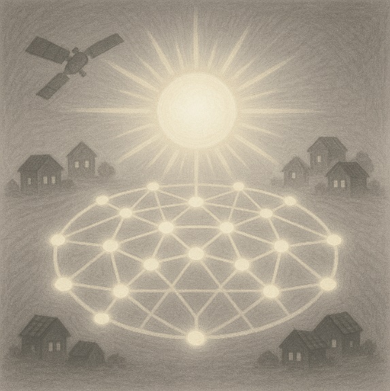
There are moments when the history of humanity accelerates to the edge of consciousness, and everything forces us to look ourselves in the eye as a species. Not out of a desire to discover new frontiers, but out of the urgency to reconsider the very foundations of our continuity. The past two centuries—since the beginning of the industrial revolution—have witnessed a dizzying technological rise, driven by an apparently inexhaustible availability of fossil fuels. This cheap, concentrated, and powerful energy has allowed us to build complex civilizations, but it has also sown the seeds of a dependency that today threatens to collapse our world.
For the first time, the human species senses that it may reach the limit of its own success: an invisible concrete wall, made of energy finitude, environmental degradation, and political inertia. The looming crisis is not a temporary or local crisis, but systemic and global. And in the face of this reality, patches and empty technological promises are not enough. The future demands a deep, structural, and deliberately strategic shift.
Sunthereum arises precisely from this radical need. It is not a technology, nor a company, nor an enthusiastic utopia. It is a structural, systemic proposal that starts from a principle as ancient as it is luminous: the sun is, and always has been, the primary source of life and energy. And from this certainty, it builds an architecture for the future. A new way to generate, distribute, consume, and govern energy, based on decentralization, resilience, and long-term sustainability.
Sunthereum is a systemic and modular energy architecture, conceived to replace the fossil-fuel-based model through a new energy matrix founded on the sun. It integrates technologies, strategies, and governance methods to guarantee generation, transport, and distribution of energy that is decentralized, resilient, efficient, and sustainable for centuries. It is based on seven interconnected pillars that work in a coordinated way to provide a structural and lasting response to the global energy challenge.
Faced with the growing risk of Blackout Stage Energy (BSE), the progressive or sudden collapse of global energy availability, Sunthereum proposes a shift that does not depend on technological miracles, but on a new way of thinking. It is no longer about having large power plants that supply millions, but about building a living, organic network made up of millions of small interconnected nodes. It is no longer about consuming energy as if it were infinite, but about managing it as a sacred, shared, transparent, and traceable good.
Sunthereum is not a product of naïve technological faith, but a rigorous and multidimensional proposal that combines science, strategy, and planetary awareness. It does not aim to replicate the mistakes of the centralized model with new materials, but to create a living energy ecosystem, distributed and capable of adapting to the environmental, social, and technological changes to come. It is, in essence, a bet on a new energy culture, where the generation and consumption of energy are no longer synonyms of domination or exploitation, but of cooperation and balance.
This chapter aims to make this vision comprehensible. We will explain the foundations that support Sunthereum, break down each of its pillars, and explore its transformative potential, both locally and globally. Because if the future is still possible, it will be thanks to ideas like this: sober but ambitious, realistic but visionary.