
 Català
Demography, Industry, Power and Historical Continuity: The Difference Between Preparing for the Future and Managing the Present

1. A 4.5% That Explains Much More Than It Seems
On October 19, 2026, China announced that its economy had grown by 4.5% year-on-year during the third quarter of the year. A figure that, observed in isolation, might seem like just another economic statistic, destined to fuel, for a few hours, analyses of financial markets, economists’ assessments and the usual discussions about the strength or weakness of the Chinese economy. But behind this percentage lies a transformation of historical dimensions that can hardly be understood by examining only the results of a single quarter.
The data present an apparently contradictory combination. While the technology industry and the manufacture of advanced equipment continue to expand, the real estate sector is experiencing a profound contraction and domestic consumption shows limited dynamism. During the first nine months of the year, production in high-technology industries increased by 14.3%, while real estate investment decreased by 20.6%. The production of industrial robots, for its part, grew by 29.1%. These are movements of considerable magnitude occurring simultaneously within the same economy.
Conventional economic analysis tends to examine these phenomena as a set of imbalances. Weakness in the real estate sector constitutes one problem; moderation in domestic consumption, another; industrial and export strength, a factor that makes it possible to offset them. From this perspective, the main question is to determine how long growth can be sustained and what measures the government will have to adopt to correct the difficulties identified.
This interpretation, following traditional Western parameters, has its usefulness in understanding the economic situation. But there is another way of examining the same phenomena: placing them within a time horizon spanning several generations and asking whether the transformations observed respond, at least partially, to a strategic orientation that transcends the immediate needs of the economy.
The question changes radically when we stop looking exclusively at today’s growth and begin considering the conditions that will determine China’s productive capacity, prosperity and stability thirty, fifty or eighty years from now. A reduction in real estate activity may acquire a different meaning when viewed from the perspective of a population that will decline profoundly during the 21st century. An extraordinary expansion of industrial robotics may be interpreted differently when related to the future reduction of the working-age population. And a persistent policy of technological development may reveal an ambition far broader than the simple desire to win international markets.
For years, demographic projections have made it possible to anticipate an extraordinary transformation of Chinese society. Its population will decline and age, but the most significant phenomenon will be the change in the proportions between generations. The population of potentially working age will decrease sharply, while the younger generations that will have to replace it will become progressively less numerous, and the senior population will represent an increasing proportion of society as a whole. This transformation, known decades in advance, presents a structural challenge that no short-term economic policy can resolve on its own.
Preparing a society for this future requires transforming the foundations of its productive capacity and, simultaneously, developing the instruments that will make it possible to care for an ageing population without absorbing an increasing proportion of the available human resources. Artificial intelligence, robotics, industrial automation and assistive technologies thus acquire a dimension that goes far beyond business competition. They become potential instruments for preserving the economic capacity, personal autonomy and quality of life of a society that will experience a demographic transformation unprecedented in its modern history.
This perspective also requires reconsidering the relationship between present economic decisions and their future consequences. Projections do not describe an inevitable destiny. They show trajectories conditioned by known circumstances and by the assumptions used to calculate them. The decisions a society makes today can modify the conditions that will determine its future. Strategic planning consists precisely of identifying these trajectories, anticipating their consequences and acting sufficiently early for the necessary transformations to unfold.
It is from this perspective that we propose to examine contemporary China. Its industrial, technological, demographic, energy and geopolitical decisions can be studied individually, but they can also be interpreted as interrelated components of a broader historical orientation. This is the central hypothesis we develop: China is building the conditions it considers necessary to preserve its autonomy, its prosperity and its continuity as a great civilization over the coming generations.
The contrast with the West appears when we ask ourselves which visions of the future guide the decisions of today’s great powers. The United States and Europe possess extraordinary economic, scientific, technological and human resources. The question is to what extent these resources are organized around persistent strategic purposes, capable of transcending electoral cycles, market fluctuations and the political urgencies of the moment.
To understand this difference, we must abandon, for a moment, the perspective that measures history in quarters and begin to observe it in generations.
Because the 4.5% growth announced today is a fact of the present. The question that truly interests us is what China is building for the future. And it is certainly building something it has already defined.
2. China Already Knows Where It Wants to Go
One of the most profound differences between China and the great Western powers lies in the way they conceive of time. While much of Western politics operates within horizons conditioned by electoral cycles, immediate economic results and short-term urgencies, China maintains a strategic orientation that extends over decades and which, in its deepest dimension, is related to the historical continuity of a millennia-old civilization. This difference does not mean that China knows the future or that its decisions are always correct. It means that it possesses a conception of its own destiny that allows present decisions to be placed within a long-term project of transformation.
Contemporary China is the result of a succession of extraordinary transformations. Since the reforms promoted by Deng Xiaoping in the late 1970s, the country has gone from a predominantly rural economy, with enormous material and technological limitations, to becoming one of the world’s leading industrial, commercial and scientific powers. This transformation has required massive investments in infrastructure, education, productive capacity, technology and institutional organization. It has also brought considerable contradictions, imbalances and social costs. But, viewed as a whole, it reveals a capacity for mobilization and transformation that can hardly be explained as a simple succession of short-term decisions.
The five-year plans constitute one of the most visible expressions of this orientation. Each period establishes priorities, objectives and instruments that guide the actions of government administrations, state-owned enterprises and a significant part of the economic system. However, their significance goes beyond five-year planning. Successive stages are articulated with development objectives extending over decades, such as those established for 2035 and for the middle of the 21st century. What is particularly significant is the possibility of profoundly modifying economic policies without necessarily abandoning the strategic purposes that guide them.
The China of Deng Xiaoping progressively opened its economy to foreign investment, international trade and market mechanisms. The China of the following decades developed extraordinary manufacturing capacity, integrated itself into global production chains and built infrastructure that transformed the country. Today’s China devotes increasing attention to technological autonomy, robotization, artificial intelligence, advanced energy technologies, the security of strategic resources and aerospace development. This last field deserves particular attention: China has been researching for decades the possibility of generating solar energy in space and transmitting it wirelessly to Earth, a technology still under development which, if it becomes industrially and economically viable, could profoundly transform the conditions of energy availability over the coming centuries. The instruments have changed because the country’s needs have also changed. Continuity is manifested in the determination to strengthen its development capacity and reduce the dependencies that could compromise its future.
This distinction between purposes and instruments is fundamental. An economic policy may be appropriate during one historical stage and cease to be so when circumstances change. The massive construction of housing, for example, may respond to extraordinary needs during a process of accelerated urbanization, but lose part of its justification when demographic growth stops and housing needs evolve. A labour-intensive industry may constitute an effective instrument of development for decades and subsequently require a radical transformation in the face of population ageing. Strategic capacity consists of recognizing these changes and reorganizing the instruments without losing sight of the purposes.
For this reason, historical continuity must not be confused with immobility. A society that aspires to preserve itself over generations needs to transform itself constantly. It must be capable of abandoning activities that have lost their function, developing capacities that it does not yet fully need and assuming present costs to avoid future dependencies. In this sense, long-term planning constitutes a form of anticipation: it makes it possible to begin today transformations whose main results may only become visible twenty, thirty or fifty years from now.
The Chinese historical dimension also introduces an element that transcends economics. China recognizes itself as the heir to a civilization with a cultural continuity and an identity of its own extending over millennia. This continuity has endured dynasties, wars, territorial fragmentation, invasions, revolutions and profound institutional transformations. The current Chinese state is a contemporary political construction, but its conception of national identity incorporates this historical memory. The preservation of territorial unity, autonomy in relation to foreign powers and the recovery of a central position in international affairs form part of a national narrative that profoundly conditions political priorities.
From this perspective, economic, military and technological power acquires a meaning that goes beyond international competition. Its function can be interpreted as the construction of the conditions that will allow China to continue being China, determine its own destiny and prevent decisions taken beyond its borders from compromising its stability. This is the interpretation we propose as the central axis of the article: the higher purpose of Chinese strategy would be to preserve the continuity, cohesion and prosperity of its civilization over the coming centuries. It is not a matter of attributing an explicit millennia-long intention to every government decision, but of examining whether its major orientations are consistent with this historical purpose.
This interpretation also helps to understand certain features of Chinese international behaviour. Its external projection is strongly manifested through trade, investment, infrastructure financing, participation in supply chains and the establishment of lasting economic relationships. These relationships can generate shared benefits, but also dependencies, power asymmetries and the capacity to exert political pressure. China defends its interests with determination and maintains important territorial and strategic disputes, especially in its regional environment. However, its worldwide economic expansion has not generally taken the form of a policy of overseas territorial conquest. Its capacity for influence is built primarily through economic, technological and diplomatic presence, although this may be accompanied by pressure and coercion.
The difference is relevant because it allows us to distinguish between two possible conceptions of power. One consists of regarding supremacy over others as a purpose that must be permanently preserved. The other consists of developing the power necessary to guarantee one’s own continuity, autonomy and capacity for decision-making. In practice, these two conceptions may coexist and generate tensions. But our hypothesis is that historical continuity occupies a particularly important place in the way China interprets its strategic interests.
This orientation may help explain a characteristic that we could call strategic tranquillity: the ability to maintain a long-term course without allowing every international crisis, every economic fluctuation or every political confrontation to alter essential purposes. This tranquillity does not imply indifference to events or the absence of conflicts. It implies possessing a hierarchy of priorities that makes it possible to distinguish what truly affects the country’s future from what constitutes a short-term disturbance. It is a capacity that depends both on the clarity of objectives and on confidence in the instruments available to achieve them.
Naturally, a persistent strategic orientation also entails risks. The concentration of decision-making may facilitate the execution of major projects, but it may also prolong errors, reduce correction mechanisms and hinder the expression of dissent. Planning may anticipate structural transformations, but no political system possesses perfect information or can eliminate uncertainty. The continuity of a project does not guarantee that all its purposes are compatible with one another. Stability, prosperity, security and political control may come into tension. Understanding Chinese strategy requires keeping these limitations in mind, because a rigorous interpretation must distinguish between the coherence of a project and the actual success of its decisions.
The contrast with the West, therefore, does not consist of claiming that some plan and others do not. The United States and Europe possess extraordinary scientific institutions, companies capable of driving worldwide technological transformations and government administrations that also develop long-term policies. The difference we are interested in examining is the capacity to articulate these initiatives within a shared, persistent and sufficiently stable strategic orientation capable of surviving political changes. When national priorities are constantly redefined, projects that require decades to mature may become conditioned by decisions taken within much shorter horizons.
The decisive question, then, is the relationship between the time of politics and the time of historical transformations. Demography evolves over generations. The training of scientists and engineers requires decades. Building complex industrial capacities requires sustained investment, accumulation of knowledge and institutional continuity. Energy security and technological autonomy can hardly be improvised when a crisis arises. Societies that possess sufficiently broad strategic horizons can begin to act before these needs become urgent.
This is the perspective from which we will examine China’s demographic and industrial transformations. Present decisions acquire a different meaning when we relate them to the conditions the country will have to face during the second half of the 21st century and, beyond that, in the 22nd century. The question is no longer only what difficulties it is resolving today, but what capacities it is building to confront problems that have not yet fully manifested themselves.
Because knowing where one wants to go does not mean knowing every obstacle along the way. It means possessing a sufficiently persistent purpose to continue moving forward, transforming the instruments whenever reality requires it.
3. Demography: The Future That Could Already Be Seen Decades Ago
There are historical transformations that occur suddenly, altering the political, economic and social conditions of a country in a matter of days or months. There are others that advance slowly, over decades, almost imperceptibly to a society accustomed to interpreting reality through immediate events. Demography belongs to this second category. Its movements are slow, but their consequences can become extraordinarily profound, because they progressively modify the human foundations upon which the economy, institutions and the very continuity of a society rest.
China has known for many years about one of the most important demographic transformations in its modern history. United Nations projections, available for decades and periodically revised, already made it possible to anticipate a very considerable reduction in its population during the 21st century. But the magnitude of this decline, however impressive it may seem, constitutes only one part of the phenomenon. The deepest transformation lies in the change in generational structure: the relationship between young people who have not yet reached working age, adults who constitute the potentially active population and older people who have passed that stage of life.
To understand its consequences, we can consider three major demographic groups: young people aged zero to nineteen, adults aged twenty to sixty-nine and the senior population aged seventy or over. This classification, which we use in our study of demographic evolution, makes it possible to observe a reality that overall population figures often conceal. A society may experience a moderate decline in its total number of inhabitants while undergoing a much more intense reduction in the generations that constitute the potential basis of its productive activity.
Demographic projections prepared before the 2020 pandemic already clearly showed this trend in China. Starting from a total population of approximately 1.425 billion inhabitants, the United Nations’ central scenarios pointed to a very considerable decline over the following decades, which could bring it below 800 million towards the end of the 21st century. The adult population, however, presented an even more significant trajectory: from approximately 980 million people of potentially working age at the beginning of the period, it could fall to fewer than 400 million by the end of the century. Beyond the precision of these figures, conditioned by the assumptions of each projection, the direction of the process was unequivocal: China was moving towards a society with far fewer inhabitants and, proportionally, even fewer people of working age.
However, the most revealing phenomenon appears when we break down the population that falls outside the ages usually considered active. This population comprises two groups with profoundly different temporal meanings. Young people represent the generations that, over the following years, will progressively join the adult population. Seniors represent the generations that, for the most part, have already completed their working lives. Grouping them under a single category of dependent population may be useful for calculating certain economic relationships, but it conceals an essential difference: the former constitute the future renewal of the active population, while the latter generate growing needs for pensions, healthcare, personal assistance and services adapted to ageing.
The importance of this transformation becomes particularly visible when we observe the evolution of the relative weight of the active and passive populations within Chinese society as a whole. Demographic projections show how, during the 21st century, the proportions of these two major groups tend to converge until they reach almost complete balance. The following chart makes it possible to visualize the magnitude of this change and, above all, the persistence of a trend that unfolds over several generations.
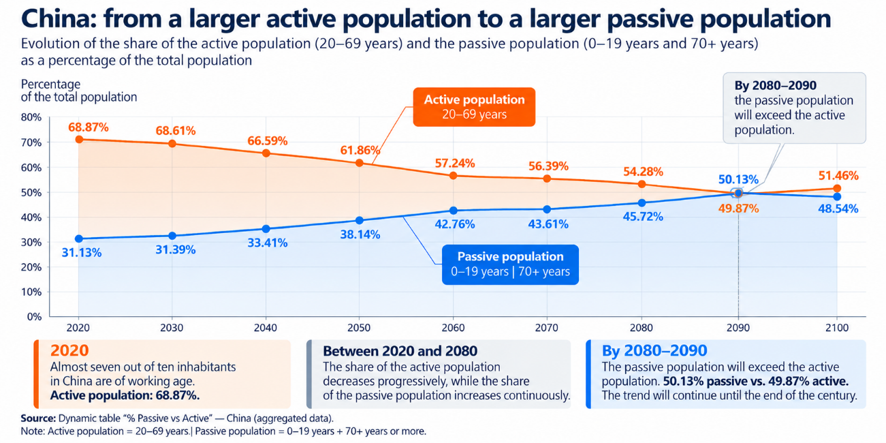
Figure 1. Projected evolution of the active population (20–69 years) and passive population (0–19 and 70 years or over) in China, 2020–2100. Author’s own elaboration based on United Nations demographic projections.
It was precisely in this relationship that the Chinese projections showed an extraordinary transformation. During the first decades of the 21st century, the number of young people and older people still maintained relatively similar proportions, with an initial predominance of the young. Over time, however, their trajectories diverged profoundly. The young population declined, while the senior population increased and came to represent an increasingly important part of society as a whole. By the middle of the century, the difference between these two groups could already be very considerable. China was moving towards a generational structure in which older people would be far more numerous than the children and adolescents who would have to constitute the subsequent productive generations.
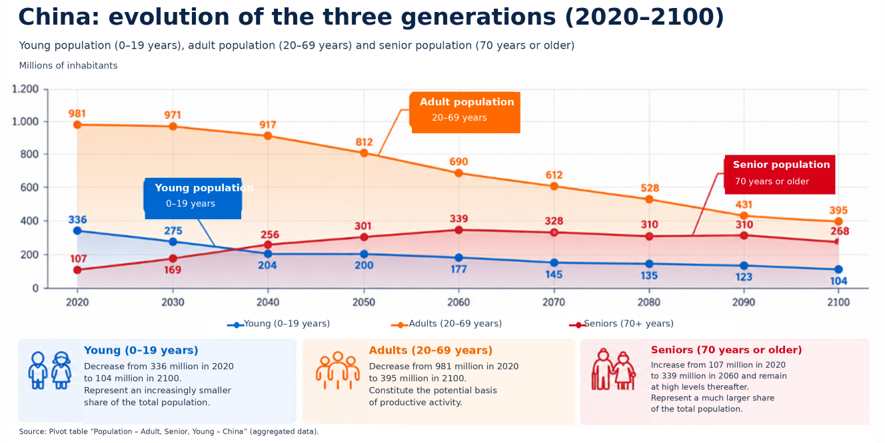
Figure 2. China’s generational transformation (2020–2100). Evolution of young people (0–19 years), adults (20–69 years) and seniors (70+). The projection highlights the decline in the young population and the ageing of the population.
This observation substantially changes the interpretation of the demographic future. The problem does not simply consist of a smaller active population having to support a higher proportion of older people. It also consists of the fact that the generations destined to renew that active population will become progressively less numerous. The decline in the birth rate is transmitted to the productive structure with a delay of decades, but once initiated, it conditions the composition of successive generations. A smaller young cohort will give rise, years later, to an equally smaller adult cohort, although its final size will also depend on mortality and migration flows.
Demography therefore has a characteristic that makes it one of the most important fields of strategic planning: a large part of its future consequences is already incorporated into the structure of the present population. The adults a country will have twenty years from now are, to a very large extent, the children and adolescents already living there today. The people who will reach retirement during the coming decades also belong to the present generations. This reality provides a capacity for anticipation that other economic or political phenomena can hardly offer with such clarity.
Policies intended to modify demographic trends can have important effects, but these effects need time to unfold. An increase in the birth rate can immediately begin to change the number of births, but the new children will need approximately two decades to become fully incorporated into economic activity. A significant transformation of the generational structure may require one or several generations. For this reason, a society that identifies in advance a profound decline in its active population needs to develop other instruments that will allow it to sustain its economy throughout the long period of transition.
Here we encounter one of the most important strategic relationships in China’s transformation: the connection between demography, productivity and technology. An economy with fewer people of working age can maintain or expand its productive capacity if it succeeds in sufficiently increasing the amount of value generated by each worker. Mechanization had already made it possible to multiply human productivity during previous industrial revolutions. Robotization, artificial intelligence, automated manufacturing systems and advanced control technologies open up the possibility of an even deeper transformation, in which an increasing proportion of productive activities can be carried out with much less direct human intervention.
China is developing precisely these capacities. Its expansion in industrial robotics, automation, artificial intelligence and advanced manufacturing responds to various economic and strategic objectives, among which competitiveness, productivity and technological autonomy stand out. But, examined from a demographic perspective, this transformation acquires an additional meaning: it contributes to preparing a productive structure capable of functioning with considerably less human labour available in the future. The convergence of these two major trends makes it possible to propose an interpretation that transcends immediate industrial policy. China would be building in advance part of the technological response to a demographic transformation it has known about for decades.
This technological response also has a second dimension that is particularly important. Population ageing not only proportionally reduces the availability of people of working age, but also increases the need for healthcare services, personal assistance, mobility, rehabilitation and long-term care. In a society with a very large senior population, an increasing proportion of human resources might have to be devoted to these activities. This creates an additional tension: while the availability of workers declines, demand increases for services that have traditionally required intensive human intervention.
Robotics and artificial intelligence can also contribute to transforming this reality. Intelligent monitoring systems, personal assistants, robotic mobility devices, rehabilitation technologies, the automation of certain healthcare tasks and, eventually, specialized humanoid robots can extraordinarily expand the capacity to care for older people. Some of these technologies already have concrete applications; others still require development, experimentation and validation. But their orientation is significant: they make it possible to imagine a society in which a much larger senior population can retain greater personal autonomy and receive certain services with a proportionally lower need for direct human labour.
The consequences of this transformation could be twofold. On the one hand, technology would contribute to maintaining and expanding industrial productive capacity despite the decline in the active population. On the other, it would make it possible to increase the efficiency of care services and reduce the pressure that ageing will exert on the availability of workers. Some of the people who, under other circumstances, would have to devote themselves to repetitive care tasks could direct their activity towards other economic and social functions. At the same time, the senior population could have more instruments to preserve its independence, security and quality of life. Technology would thus act simultaneously on production and on the needs arising from ageing.
This dual function makes it possible to understand that technological transformation should not be assessed solely according to the number of workers it replaces or the profits it generates for companies. Its strategic importance also lies in its capacity to reorganize the whole range of economic and social activities in the face of a radically different demographic structure. A society with fewer inhabitants, fewer adults and more older people needs to produce, distribute, provide care and organize itself differently. Technology can become a fundamental instrument of this reorganization, provided that its development translates into effective, accessible and economically sustainable applications.
Demographic decline does not necessarily determine a decline in individual prosperity either. The total output of an economy depends on the amount of labour available, but also on productivity, capital, technology and the organization of productive processes. A smaller population can enjoy a higher income per inhabitant if productive capacity evolves favourably. In strictly mathematical terms, maintaining the same gross domestic product with a smaller population implies an increase in GDP per capita. But real prosperity will also depend on income distribution, the availability of services, social needs and the capacity to transform productive advances into effective well-being.
This opens up a perspective that is often overshadowed by alarmist interpretations of demographic decline. The China of the future could have a population considerably smaller than today’s and, at the same time, a much higher technological, industrial and economic capacity per inhabitant. A less populous but highly productive and automated society, capable of providing advanced services to its population, could maintain extraordinary international influence. This possibility does not constitute an inevitable prediction, but rather a scenario consistent with sustained technological transformation over several generations.
There is yet another variable that deserves consideration, although it does not constitute the centre of this reflection: the international mobility of human capital. For decades, numerous Chinese citizens and descendants of families of Chinese origin have developed their professional, scientific and business careers in other countries. If China’s economic and technological transformation generates growing opportunities, some of this talent could find incentives to settle there or return. This possibility includes both professionals born in China and members of later generations of Chinese communities established abroad. The magnitude and consequences of these movements will depend on economic, social, political and personal factors, but they constitute an additional means of adapting to future needs for qualified human capital.
What is particularly revealing about this entire process is its temporal dimension. The demographic transformations that will profoundly condition China during the second half of the 21st century could already be identified many years earlier. The technologies that can contribute to addressing them, in turn, require decades of research, investment, industrial development and social implementation. The relationship between these two realities is therefore a matter of strategic anticipation. Preparing the capacities that a society will need fifty years from now requires beginning to build them when they do not yet seem indispensable.
This is one of the keys to interpreting China’s orientation. Population decline, ageing, the reduction of younger generations and the transformation of social needs are processes that will unfold over many decades. Robotization, artificial intelligence, industrial reorganization and assistive technologies may form part of the response to these processes. Their present development may contribute to determining the conditions of prosperity and stability for the generations that will live during the second half of the 21st century and the first decades of the 22nd.
Demography ultimately shows us a fundamental characteristic of historical time: many of the conditions that will determine the future already exist, even though their consequences are not immediately visible. Societies that know how to identify them have the opportunity to act before they become urgent problems.
And China has known for decades about the demographic transformation it faces. The decisive question is how it is reorganizing its economy to address it.
4. The Real Estate Sector: The Difference Between Building and Speculating
For decades, construction has been one of the great engines of China’s economic transformation. Industrial development, accelerated urbanization and the movement of hundreds of millions of people from rural areas to cities generated extraordinary demand for housing, infrastructure and urban facilities. The construction of new cities, transport networks, industrial facilities and large residential concentrations contributed decisively to transforming the country’s territorial, economic and social structure. That activity responded to a specific historical need: to provide the material conditions that would make it possible to accommodate one of the greatest urban transformations humanity has ever known.
But an activity that is necessary during one stage of development may progressively lose its original function when circumstances change. Urbanization cannot grow indefinitely at the same pace, housing needs evolve and the accumulated stock of construction modifies the conditions of future demand. When, moreover, demographic projections anticipate a profound decline in population over the following decades, the continuation of an economic model based on permanent real estate expansion raises questions that go far beyond the immediate profitability of construction companies.
This distinction is fundamental: building housing to satisfy real needs constitutes a productive activity with a defined economic and social function. Building housing primarily because its price will continue to rise introduces a different logic, in which the expectation of appreciation may eventually replace the need for use as the principal justification for investment. When this dynamic is combined with an intense expansion of credit, real estate activity may acquire dimensions disproportionate to the actual needs of society.
Recent economic history offers sufficiently well-known examples of this transformation. In Spain, during the years preceding the 2008 financial crisis, residential construction and real estate financing acquired extraordinary importance within the economy as a whole. The persistent increase in prices fuelled expectations of further appreciation, while credit facilitated the continuation of the process. Construction generated activity, employment, tax revenues and business profits, but an increasing part of that dynamism depended on the possibility of continuing to expand the same mechanism. When financial conditions changed and expectations collapsed, the consequences affected the banking system, companies, public administrations and millions of citizens.
China presents institutional, financial and economic characteristics very different from those of Spain, but it also experienced extraordinary real estate expansion. For years, the sector absorbed immense quantities of capital and became a fundamental component of economic activity, local government financing and the accumulation of wealth by many families. Rising prices, developers’ indebtedness and dependence on future sales contributed to generating imbalances that became increasingly evident.
From 2020 onwards, the Chinese authorities introduced significant financial restrictions on property development companies, particularly through the criteria known as the three red lines, intended to limit certain indebtedness indicators. These measures responded to concern about accumulated financial risk and the determination to reduce dependence on a model of real estate expansion sustained by credit. The subsequent difficulties of major developers, falling sales and contracting investment revealed the magnitude of the existing imbalances and the costs that correcting them could entail.
The usual interpretation of this crisis focuses on declining activity, the loss of asset value, business difficulties and the consequences for economic growth. These are real problems that affect families, creditors, public administrations and the economy as a whole. But from a long-term strategic perspective, another question arises: what sense would it make to continue allocating an extraordinary proportion of a country’s financial and productive resources to indefinitely expanding its housing stock when its demographic and economic needs are changing profoundly?
The future decline in population does not automatically imply a proportional reduction in housing needs. Household size, ageing, internal migration, urban concentration and territorial distribution can considerably modify residential demand. Some regions may continue to need new housing while others accumulate underused properties. But the prospect of a declining population makes it necessary to abandon the idea that the quantitative expansion of construction can indefinitely constitute a central engine of economic development.
It is here that Chinese real estate policy acquires a possible broader strategic meaning. The containment of indebtedness, the reduction of speculative expansion and the reorientation of economic priorities can be interpreted as parts of a transformation of the growth model. The capital, industrial resources and technological capacities that, during one historical stage, contributed to building housing and infrastructure can progressively be directed towards activities that prove more relevant to the country’s future needs.
This reorientation coincides with the extraordinary development of sectors such as electric vehicle manufacturing, the photovoltaic industry, batteries, robotics, automation and other advanced technologies. China has promoted these activities through a combination of industrial policies, public and private investment, technological development, financing and expansion of productive capacity. This is not to claim that resources withdrawn from the real estate sector have been transferred directly and entirely to these industries, but rather to observe a change in the relative importance acquired by different activities within the country’s economic orientation.
The difference between these two destinations for capital is particularly significant when we examine them from the perspective of the 21st century. Housing constitutes an essential good when it responds to a residential need, but the indefinite construction of housing without sufficient demand can immobilize enormous quantities of resources and generate financial risks. By contrast, the development of advanced industrial capacities can provide productive instruments that continue to evolve, incorporate knowledge and generate new applications over decades. The manufacture of robots, energy systems, batteries and control technologies not only produces goods intended for today’s market; it also contributes to building the capacities that will make it possible to develop subsequent technological generations.
This distinction does not mean that every technological investment is necessarily efficient or that advanced industrial sectors are exempt from imbalances. Productive overcapacity, unprofitable investments, excessive competition and commercial difficulties can arise in any activity. The strategic difference lies in the function these capacities can perform within a project of economic transformation. A society that expects to have fewer workers over the coming generations needs to develop instruments that increase productivity and reduce certain dependencies. Advanced technology industries can contribute directly to this purpose.
Economic policy, viewed from this perspective, ceases to be merely an instrument for stimulating or moderating immediate activity. It also becomes a mechanism for directing the distribution of resources between present needs and the capacities that will be required in the future. This function requires making decisions that may prove unpopular, assuming transition costs and accepting that certain sectors lose relative importance while others require years of investment before reaching full maturity.
The Chinese real estate case illustrates the difficulties of this transformation. The sector’s contraction affects household wealth, consumer confidence, corporate solvency and local government revenues. These consequences condition current growth and may hinder the very process of economic reorientation. A long-term strategy does not eliminate present problems or guarantee that the instruments chosen are the most appropriate. Its distinctive characteristic is that decisions can respond to a hierarchy of priorities that incorporates future needs, even when this entails managing immediate tensions.
In this sense, the central question is not whether China’s real estate crisis is an economic problem. Evidently, it is. The question is whether, simultaneously, the sector’s transformation forms part of a broader process of reorganizing the country’s productive foundations. Demographic decline, ageing, the need to increase productivity and the determination to strengthen technological autonomy provide sufficient elements to consider this interpretation.
The contrast with Western economies appears when we examine the difficulty of modifying economic structures that generate immediate profits, employment, tax revenues and financial valuations, even when their continuation may increase future vulnerabilities. Market pressure, sectoral interests and short political horizons can hinder transformations that require prolonged periods of transition. This difficulty is not exclusive to the West, but it is particularly visible in systems where a significant proportion of economic decisions are evaluated according to their immediate effects.
The capacity to recognize that an activity has completed an essential part of its historical function and that resources must begin to be directed towards new needs constitutes an important expression of strategic anticipation. Building housing was indispensable to transforming rural China into a profoundly urbanized society. Developing advanced industrial, technological and energy capacities may prove equally indispensable to preparing a society that will have to maintain its prosperity with a progressively smaller and older population.
The question, ultimately, is to understand that a society’s needs change over time and that the continuity of its development requires transforming the economic instruments it uses. What contributed decisively to building the China of the 20th century may not be sufficient to sustain the China of the 21st century, and even less so that of the 22nd century.
Building the future also begins when a society decides to stop building what it will no longer need to the same extent.
5. From the Strength of Labour to the Strength of Technology
During a considerable part of its economic transformation, China possessed an extraordinary advantage: an immense working-age population, progressively incorporated into an increasingly extensive and sophisticated industrial structure. The availability of human labour, combined with massive investments in infrastructure, productive capital, education and industrial organization, made it possible to develop unprecedented manufacturing capacity. The country became one of the world’s leading centres of production, initially in labour-intensive activities and, progressively, in sectors of increasing technological complexity.
That model responded to the conditions of a specific historical stage. Hundreds of millions of people entered industrial and urban activity, while Chinese companies accumulated productive experience, technological knowledge and organizational capacity. Competitiveness was based on a combination of labour costs, production scale, infrastructure, logistical integration and the availability of suppliers. Over time, however, China’s competitive advantage ceased to depend primarily on the cost of labour. The sophistication of industrial chains, the accumulation of knowledge, the quality of infrastructure and the capacity to manufacture increasingly complex products acquired growing importance.
The demographic transformation we have examined introduces a new requirement. A society that anticipates a profound decline in its potentially active population needs to develop a productive structure capable of maintaining and expanding its economic capacity with progressively less human labour available. This need does not suddenly appear when the number of workers declines. It can be anticipated decades in advance, because the generations that will constitute the adult population of the future are already part of the present demographic structure. The strategic question consists of beginning to transform productive instruments before the reduction in available labour becomes a decisive limitation.
Technology provides a potential response to this transformation. Mechanization made it possible to multiply human physical strength; industrial automation facilitated the performance of repetitive processes with increasingly less direct intervention; digitalization transformed information management and the coordination of productive activities. Advanced robotics and artificial intelligence now expand these possibilities, incorporating capacities for perception, adaptation, pattern recognition, optimization and the execution of tasks that previously required more intensive human participation. The transformation does not simply consist of replacing workers with machines, but of reorganizing productive processes around technological capacities that profoundly modify the relationship between labour, capital and production.
China is developing these capacities on an extraordinary scale. Industrial robotization, advanced manufacturing, automated production systems, artificial intelligence applied to industry and the development of technological components constitute priority areas of its economic transformation. The importance of this process is not limited to the number of robots installed or the production volume of particular industries. What is strategically significant is the construction of an industrial system capable of designing, manufacturing, deploying and improving the instruments that will make it possible to automate productive activities over the coming decades.
This distinction is fundamental. An economy that purchases advanced technology can increase its productivity, but it continues to depend, to a certain extent, on the capacity of other countries to develop, manufacture and supply it. An economy that progressively masters the design and production of its own technological instruments acquires an additional capacity: it can guide their evolution according to its needs, integrate them into its industrial structures and reduce dependencies that could compromise its future development. Technology ceases to be merely a factor of productivity and also becomes an instrument of strategic autonomy.
The manufacture of industrial robots illustrates this transformation particularly well. A robot is not simply a machine that replaces certain human movements. It forms part of a system incorporating sensors, motors, control systems, software, electronic components, communication capabilities and, progressively, artificial intelligence instruments. Developing a domestic robotics industry involves building competencies in numerous interrelated technological fields. These competencies can subsequently be applied to other sectors, generating an accumulation of knowledge and productive capacity that transcends the manufacture of the robots themselves.
Artificial intelligence introduces an additional dimension. During the early stages of digitalization, machines primarily executed previously defined instructions. Today’s artificial intelligence systems can analyse large quantities of information, identify regularities, assist in decision-making and adapt certain processes to variable conditions. Integrated into industrial structures, these systems can contribute to improving production planning, quality control, predictive maintenance, logistics and energy efficiency. Their importance lies not only in the capabilities of the most advanced models, but also in the possibility of extending these capabilities throughout the economy.
Here a strategic difference emerges that deserves particular reflection. Developing the most powerful artificial intelligence constitutes a technological objective of great importance, but transforming it into a widely distributed capability within industry, services and institutions can generate equally profound economic and social consequences. International technological competition will not necessarily be decided solely by who develops the most advanced systems first, but also by who succeeds in integrating them more extensively, efficiently and persistently into the everyday activities of their society.
China possesses an industrial structure particularly favourable to this integration. The concentration of suppliers, manufacturers, technology companies, research centres and logistical infrastructure facilitates the connection between the development of a technology and its productive application. This proximity can accelerate processes of experimentation, adaptation and industrialization, allowing an innovation to move from the research environment to manufacturing and the market with considerable speed. The size of the domestic market and investment capacity also contribute to expanding the scale of these transformations.
But the importance of robotization and artificial intelligence acquires even greater depth when we return to the demographic evolution we have analysed. China will not only have to produce with a smaller potentially active population, but will also have to care for a proportionally much larger senior population. This dual transformation generates needs that simultaneously affect the productive economy and care services. An increasing proportion of economic activities might have to be devoted to health, rehabilitation, mobility, personal assistance and long-term care, precisely when the relative availability of workers will be declining.
Technology can contribute to addressing both needs. Industrial robots, automated systems and artificial intelligence applied to production can increase the quantity of goods and services generated with less direct human intervention. In parallel, intelligent assistance systems, robotic mobility devices, rehabilitation technologies, health-monitoring instruments and future specialized humanoid robots can expand the capacity to care for older people. Their effective implementation will depend on technological development, costs, safety and social acceptance, but the possibilities they open up are extraordinarily significant.
This second function of technology deserves special attention because it is often overshadowed by industrial applications. An ageing society needs people to care for other people, but many activities associated with care involve physical, repetitive, monitoring or support tasks that can benefit from technological assistance. Helping a person with reduced mobility to move around, facilitating rehabilitation, detecting risk situations, managing certain daily routines or providing assistance with domestic activities are examples of areas in which robotics and artificial intelligence can contribute to expanding personal autonomy and reducing part of the workload of caregivers.
The economic consequences of this transformation could be profound. If certain care needs can be met with proportionally less human intervention, some of the available labour resources can be devoted to other productive and social activities. At the same time, care professionals will have instruments that allow them to concentrate a greater proportion of their time on functions requiring judgement, sensitivity, human relationships and personalized attention. Technology does not eliminate the human dimension of care; it can contribute to strengthening it by freeing up time and capacity for activities in which that dimension is irreplaceable.
Therefore, technological transformation can act simultaneously on two fundamental variables of the future economy: the capacity to produce and the quantity of human labour required to sustain certain services. This dual function is particularly relevant in a society in which the adult population will decline while the relative weight of senior generations increases. Technology thus becomes a potential instrument for reorganizing the balance between production, services, demographic dependency and quality of life.
The long-term perspective also changes the way technological investments are evaluated. Developing a new industry may require years of research, experimentation, high initial investment and prolonged periods before achieving satisfactory profitability. The capacities accumulated during this process may prove decisive for applications that do not yet exist or that today are only at preliminary stages of development. A society with a strategic horizon spanning several decades can evaluate these investments according to their contribution to future capacities, beyond immediate financial results.
This orientation does not eliminate the risks associated with technological development. Excessive investment, duplication of capacities, dependence on critical components, integration difficulties and the possibility of choosing technologies that subsequently prove inadequate are part of any process of industrial transformation. Planning capacity does not guarantee that every decision will be correct. But it makes it possible to coordinate sustained efforts, accumulate competencies and maintain a general orientation that transcends short-term economic cycles.
There is, moreover, a consequence that often goes unnoticed. Technology not only makes it possible to produce more with fewer people; it can also modify the nature of human labour. The automation of certain activities can increase demand for competencies related to design, supervision, maintenance, systems integration and the development of new applications. This transformation requires adapting education, vocational training and labour institutions. A society’s technological capacity ultimately depends as much on the machines it manufactures as on the people capable of developing, using and transforming them.
China therefore faces a transformation that goes far beyond the progressive replacement of human labour by automated systems. It is developing the foundations of a productive structure in which knowledge, technology, industrial integration and adaptability may acquire growing importance relative to the absolute size of the active population. This orientation is consistent with the needs of a society that will have to maintain its prosperity through decades of demographic transformation.
The decisive question will not simply be how many robots China possesses or what position its artificial intelligence systems occupy in international rankings. It will be the extent to which these technological capacities have been integrated throughout the economy and have contributed to transforming the material living conditions of the population. Technological power is fully manifested when knowledge becomes productive capacity, strategic autonomy and social well-being.
During one stage of its recent history, China built its economic strength by mobilizing an extraordinary quantity of human labour. Over the coming decades, an increasing part of its strength may depend on its capacity to multiply the value of that labour through technology.
The transformation is profound: from having many workers available to produce, to having the technology necessary to continue producing when workers become less numerous. And, simultaneously, from needing more and more people to care for an ageing society, to developing instruments that make it possible to provide better care with more efficient use of the available human resources. This is one of the great transitions that may define China in the 21st century and prepare the conditions for its continuity during the 22nd century.
6. China Exports Industrial Capacity
For decades, a significant part of Western interpretations of China’s commercial expansion was built around an apparently simple explanation: China exported because it produced cheaply. The availability of an immense workforce, relatively low wages, cost advantages and progressive integration into international trade did indeed contribute to its competitiveness during the early stages of industrial development. But this explanation, which might have been partially satisfactory forty years ago, is clearly insufficient to understand the export capacity of contemporary China.
China today exports because it has built an industrial structure of extraordinary breadth, depth and integration. Its strength lies not only in the capacity to manufacture large quantities of products, but in the concentration of competencies, infrastructure, suppliers, technologies and processes that make it possible to transform knowledge and material resources into competitive industrial goods. This structure is the result of sustained accumulation over decades and constitutes one of the country’s principal strategic assets.
To understand its importance, it is necessary to distinguish between having a factory and having an industrial system. A factory can manufacture a particular product, but it depends on a network of supplies, components, equipment, specialized services, infrastructure and knowledge that make its activity possible. When a considerable part of this network is integrated within the same economic environment, companies can reduce coordination costs, accelerate product development, adapt processes and increase their capacity to respond to market needs. Competitiveness ceases to depend exclusively on the individual characteristics of each company and comes to reflect the accumulated capacities of the productive system as a whole.
Chinese industrialization has developed precisely this kind of integration. In numerous sectors, the proximity of component manufacturers, material suppliers, engineering companies, development centres, production facilities and logistics networks enables coordination that is difficult to reproduce in economies with more fragmented industrial structures. This concentration facilitates large-scale manufacturing, but also contributes to reducing the time needed to introduce modifications, experiment with new processes and industrialize emerging technologies.
Scale constitutes another essential dimension. Producing large quantities makes it possible to distribute certain fixed costs over a greater volume of units, justify investments in automation, specialize processes and accumulate productive experience. But industrial scale is not simply a matter of size. When combined with technological learning, supplier integration and innovation capacity, it can generate advantages that progressively reinforce one another. Companies learn by manufacturing, suppliers improve their components, processes are perfected and accumulated capacities facilitate the development of subsequent products.
This accumulation of experience constitutes a form of knowledge that can hardly be acquired solely through the purchase of patents or the construction of new facilities. Industrial capacity incorporates formal knowledge, but also organizational experience, professional competencies, procedures, relationships between companies and skills acquired over years of production. A society that loses certain industrial capacities may retain the scientific knowledge necessary to recover them, but rebuilding the productive network that makes it possible to apply that knowledge may require considerable time and resources.
Here a particularly important question arises for understanding the transformation of Western economies over recent decades. Industrial relocation enabled many companies to reduce costs, increase margins and concentrate certain activities in territories with more favourable production conditions. But when this process continues over time and affects entire sectors, it can also lead to the progressive loss of productive competencies, supplier networks and industrialization capacities. An economy may continue to possess extraordinary research centres, leading technology companies and considerable financial capacity, while seeing its autonomy to manufacture certain essential products or components diminish.
The difference between inventing a technology and being capable of industrializing it thus becomes fundamental. Scientific research can generate extraordinary discoveries, but transforming them into reliable products that can be manufactured on a large scale and are economically accessible requires an additional set of capacities. Industrial processes must be developed, supplies guaranteed, materials adapted, equipment built, professionals trained and production continuously improved. Innovation does not end when an invention appears; it continues throughout the entire process that makes it possible to transform that invention into a widely used economic and social reality.
China has developed a particularly significant capacity in this second dimension. Its industrial strength facilitates the transformation of technologies into products available on a large scale, often with speed and costs that are difficult to match. This capacity is manifested in highly diverse sectors, from electronic equipment to industrial machinery, energy infrastructure, batteries, electric vehicles and numerous components essential to contemporary technologies.
The case of the photovoltaic industry is particularly illustrative. Harnessing solar energy through photovoltaic cells is the result of a long international scientific and technological evolution. But the extraordinary reduction in the costs of solar panels over recent decades is profoundly related to the expansion of manufacturing capacity, the improvement of production processes and the industrial scale achieved, especially in China. The capacity to manufacture a technology on a massive scale contributes to transforming its possibilities of use and can modify the economic conditions of entire sectors.
A similar dynamic is manifested in batteries and electric vehicles. Competitiveness depends not only on vehicle design or the characteristics of a battery, but on the integration of materials, components, manufacturing processes, electronic systems, software, production capacity and distribution networks. When these competencies develop in an interrelated manner, innovation capacity and industrial competitiveness can reinforce one another. China has built a particularly extensive ecosystem in these sectors, which helps explain its growing presence in international markets.
This industrial strength also changes the nature of commercial relationships. A country that exports consumer products participates in international trade; a country that supplies machinery, energy equipment, electronic components, industrial systems and essential technologies also contributes to determining the productive conditions of other economies. Its influence is manifested in investment decisions, supply chains, production costs and the possibilities for technological development available to its customers.
China therefore exports much more than merchandise. Through its industrial products, it projects part of the productive capacity it has accumulated over decades. When a company in another country purchases Chinese machinery, installs energy equipment manufactured in China or incorporates Chinese components into its productive processes, it is indirectly using part of this industrial structure. The capacities developed within the Chinese economy thus become instruments that contribute to the functioning of other economies.
This projection generates interdependencies. Importing countries can benefit from more accessible products, available technologies and equipment that facilitates their own economic activity. At the same time, they may develop dependencies on suppliers, components or technologies concentrated in particular territories. For China, these relationships provide markets, revenues, opportunities for expansion and capacity for influence. Commercial interdependence can generate shared benefits, but also asymmetries that acquire strategic importance when political or economic tensions arise.
Accumulated industrial capacity constitutes, in this sense, a form of power that does not necessarily need to be expressed through military instruments. The availability of essential products, technologies and supplies can condition the decisions of other countries, especially when alternatives are limited or require years of investment to develop. This economic power does not guarantee control over the decisions of others, but it expands the capacity for influence and can contribute to strengthening a country’s international position.
The Western response to this transformation has progressively taken the form of reindustrialization policies, incentives for domestic production, trade restrictions and efforts to diversify supply chains. These initiatives reflect the recognition that certain industrial capacities have a strategic importance that goes beyond conventional criteria of immediate business profitability. Recovering them, however, requires rebuilding competencies, infrastructure and productive networks that may have taken decades to develop in other territories.
Here the temporal dimension that structures our reflection reappears. Industrial capacity is a cumulative asset. It is built through investment, learning, experience, technological development and productive continuity. It can deteriorate when these activities disappear or are relocated, and rebuilding it may require periods far longer than the usual horizons of political and business decisions. For this reason, the international distribution of industrial capacity is not merely an economic question of the present; it conditions the possibilities for development and autonomy of societies over the following decades.
China also faces limitations and vulnerabilities within this system. Its industrial structure depends on international markets, imported resources, certain foreign technologies and commercial conditions that may change. The expansion of productive capacity can generate surpluses, price pressures and profitability difficulties. Trade and technological restrictions can limit access to essential components or hinder expansion into certain markets. Industrial strength does not eliminate these dependencies, but provides a material foundation from which the country can attempt to reduce them and adapt to transformations in the international environment.
The strategic importance of this productive capacity becomes particularly evident when we relate it to the demographic and technological challenges examined earlier. A society that will have to maintain its prosperity with a smaller potentially active population needs instruments that multiply productivity and make it possible to sustain a technologically advanced economy. An industry capable of manufacturing robots, automated systems, energy equipment and technological components provides a fundamental part of these instruments.
But it also offers an additional capacity: it makes it possible to participate in the productive transformation of other societies. As robotization, digitalization and the energy transition spread internationally, demand for advanced industrial equipment, components and systems may continue to grow. Countries possessing the capacities necessary to manufacture them will occupy a particularly important position within future economic chains.
This is one of the most profound differences between competing to sell products and building industrial capacity intended to endure. The sale of a product generates an immediate economic result. The development of a complex productive structure creates possibilities for manufacturing, innovation and adaptation that can be maintained and evolve over generations. Its strategic importance lies in this capacity to continue producing, transforming itself and responding to needs that do not yet fully exist.
China has converted an extraordinary part of its industrial accumulation into export capacity. But its most important asset is not necessarily the volume of merchandise it sells each year, but the productive system that enables it to manufacture those goods and that can continue transforming itself over the coming decades.
China exports products because it has built industrial capacity. And that industrial capacity is, in itself, a form of power that projects into the future.
7. Securing the Resources of the Future
An industrial power needs much more than factories, technology and organizational capacity to sustain its activity over generations. It needs access to the raw materials, energy, food, infrastructure and logistical systems that make it possible to sustain its entire economy. The availability of these resources constitutes an essential condition for productive continuity and, consequently, for a country’s strategic autonomy. A society may develop extraordinary technologies and accumulate immense industrial capacities, but remain exposed to profound vulnerabilities if it depends on supplies that other actors can interrupt or condition.
China is perfectly aware of this reality. Its transformation into one of the world’s leading manufacturing powers has multiplied its energy, mineral and logistical needs, while the size of its population requires guaranteeing a food system capable of providing stable supplies. The security of these resources therefore constitutes a question that transcends the ordinary functioning of markets. It affects the capacity to maintain economic activity, confront crises, preserve social stability and prevent certain external dependencies from becoming instruments of political pressure.
One of the most significant characteristics of China’s orientation is the combination of different instruments to reduce these vulnerabilities. Domestic production, strategic reserves, supplier diversification, international investment, infrastructure development and technological research constitute complementary components of the same need: ensuring that the country has the resources indispensable to continue functioning under circumstances that may be very different from those of today. This combination makes it possible to address immediate risks and structural transformations that will unfold over decades simultaneously.
Energy is probably the most evident example. An industrial economy of China’s dimensions needs extraordinary quantities of electricity, fuels and other forms of energy to power factories, transport, infrastructure, communications and services. Dependence on certain imported resources introduces vulnerabilities related to international prices, maritime routes, geopolitical conflicts and the decisions of producing countries. Energy security therefore requires action on several dimensions: guaranteeing supplies, diversifying sources, developing domestic production capacity and progressively transforming the technologies that make it possible to obtain and use energy.
Chinese policy combines the still very significant use of coal with the development of nuclear energy, hydroelectric power, wind energy, photovoltaics and the infrastructure necessary to integrate them into the electricity system. This combination reflects the requirements of an economy that must maintain its present supply while progressively transforming its energy structure. The availability of domestic resources, the construction of generation capacity and the development of associated industrial technologies constitute instruments for reducing certain dependencies and expanding future options.
Oil reserves provide another particularly revealing example. For years, China has developed storage infrastructure and accumulated reserves intended to strengthen supply security. These stocks can help cushion temporary disruptions, trade tensions and changes in international markets. Their importance lies not only in the volume accumulated, but in the capacity to prevent an immediate disturbance from forcing the country to adopt hasty decisions or compromising the functioning of essential sectors of the economy.
This capacity to absorb disturbances constitutes an important dimension of strategic autonomy. A society that possesses reserves, alternative suppliers and domestic production capacity can confront certain crises with greater room for decision-making than a society dependent on immediate supply. Strategic reserves represent, in this sense, a form of material anticipation: resources accumulated in the present to preserve the capacity to act in uncertain future situations.
But Chinese energy security is not limited to guaranteeing the fuels it currently needs. It also incorporates the development of technologies capable of transforming future conditions of energy production, storage, distribution and use. The manufacture of photovoltaic panels, batteries, electrical equipment, control systems and other energy components constitutes simultaneously an industrial activity, a source of international competitiveness and a potential instrument of autonomy. The country not only increases energy availability; it also develops the capacity to manufacture a considerable proportion of the instruments that will make it possible to obtain and manage it.
This perspective acquires an even broader dimension when we consider aerospace development. China is building its own capacities for launch, exploration, navigation by satellite, orbital operations and space research. These technologies have scientific, commercial, industrial and military applications, but they also open up possibilities related to energy production and transmission. Among the research lines deserving particular attention is space-based solar power, internationally known as Space-Based Solar Power (SBSP), which studies the possibility of capturing solar energy through installations located in space and subsequently transmitting it to Earth.
Wireless energy transmission, or Wireless Energy Transfer (WET), constitutes one of the technologies that could make this type of system possible. Through certain electromagnetic transmission techniques, the possibility of transporting energy from orbital installations to terrestrial receivers is being considered. Considerable technological, economic and operational difficulties still exist, and these applications do not currently constitute a commercially established alternative to terrestrial energy systems. But their research is significant because it points towards a possibility that, if successfully developed, could profoundly modify the conditions of energy availability over the coming centuries.
The strategic importance of this research lies precisely in its time horizon. A technology that still requires decades of development may seem secondary when evaluated according to immediate economic results. But if its future maturity could transform an essential sector such as energy, beginning to develop it well in advance may provide scientific, industrial and institutional capacities that would be difficult to improvise later. Aerospace research, examined from this perspective, also constitutes an investment in future options that cannot yet be fully evaluated.
Energy is only one part of the question. The worldwide technological transformation is increasing the importance of numerous minerals and materials essential for manufacturing batteries, electric motors, electronic equipment, semiconductors, energy systems and other advanced products. Lithium, copper, nickel, cobalt, graphite and various rare-earth elements are examples of resources involved in different stages of these productive chains. Their availability, processing capacities and the geographical concentration of certain activities can generate dependencies of great strategic importance.
China has developed a particularly significant presence in various mineral-processing activities, component manufacturing and the integration of industrial chains related to these technologies. This capacity does not mean that it possesses all the resources it needs within its territory. Precisely for this reason, its policy combines domestic production, imports, international investments and the development of refining and transformation capacities. Control over certain industrial stages can be as important as the physical availability of resources, because minerals only acquire technological utility when they can be transformed into materials and components suitable for manufacturing.
This distinction makes it possible to understand why supply security cannot be resolved merely by accumulating raw materials. An economy also needs the industrial, technological and logistical capacity that makes it possible to transform them and incorporate them into productive processes. The extracted mineral, the refined material, the manufactured component and the final product form part of a chain in which each stage can generate dependencies. Strategic strength depends on the capacity to identify these vulnerabilities and develop instruments to reduce them.
Food security introduces another fundamental dimension. Feeding a population of extraordinary dimensions requires combining agricultural production, land availability, water resources, technology, storage, transport and international trade relationships. Climate change, geopolitical crises, animal epidemics and logistical disruptions can affect food availability and prices. For this reason, domestic production of essential cereals, food reserves, supplier diversification and agricultural technological development constitute important elements of economic and social stability.
This concern acquires special significance when we relate it to historical continuity. Food crises have had profound political and social consequences throughout the history of numerous civilizations, including the Chinese civilization. Guaranteeing food supplies therefore constitutes an immediate material need and, at the same time, a fundamental condition for preserving the stability of a society over prolonged periods. Food security is not merely an agricultural question; it forms part of the general architecture of national security.
Transport and logistical infrastructure complete this structure. Ports, railways, roads, oil pipelines, gas pipelines, electricity networks and communication systems make it possible to connect resources, production centres and markets. Their availability and diversification help reduce the risks associated with dependence on single routes or vulnerable transit points. Chinese investments in infrastructure both inside and outside the country can also be interpreted from this perspective: expanding transport options, strengthening commercial connections and increasing the capacity to maintain economic flows under changing circumstances.
China’s international projection thus acquires a meaning that goes beyond simple commercial expansion. Investments in mines, infrastructure, energy, transport and industrial activities can contribute to guaranteeing access to resources and markets over prolonged periods. These relationships generate economic opportunities for participating countries, but they can also create financial, technological or commercial dependencies and expand China’s capacity for influence. Their strategic importance lies in the possibility of building lasting ties that contribute to securing the country’s future needs.
One of the most significant expressions of this orientation is the Belt and Road Initiative (BRI), also known as the New Silk Road, promoted by China since 2013. This initiative brings together investments, cooperation agreements and infrastructure projects intended to strengthen land, maritime, energy and commercial connections between China and numerous regions of the world. Beyond immediate economic benefits, the construction of railway corridors, ports, energy networks and logistical connections can contribute to diversifying supply routes, facilitating access to strategic resources and consolidating lasting relationships with producing and transit countries. Its importance also lies in this temporal dimension: the infrastructure built today can condition trade flows, economic dependencies and development possibilities over several generations. The BRI thus constitutes a particularly revealing example of how international economic projection can become an instrument of strategic continuity.
The difference between possessing a resource and having stable access to that resource is particularly important. An industrial power does not necessarily need to territorially own all the raw materials it uses. It can guarantee part of its supply through contracts, corporate shareholdings, infrastructure, diplomatic relationships and commercial diversification. These forms of access do not eliminate risks, but they make it possible to develop instruments of influence and security that do not depend exclusively on direct territorial control.
Here the distinction between strategic purposes and the instruments used to achieve them reappears. Oil reserves, the manufacture of solar panels, the development of aerospace technologies, international mining investments and the construction of infrastructure may seem like very different activities when examined individually. But all can contribute, through different paths, to the same purpose: reducing the country’s vulnerability to future circumstances that could compromise its productive capacity and autonomy of decision-making.
This interpretation does not imply that all Chinese actions respond to a single perfectly coordinated plan or that its decisions are free from contradictions. Companies, government administrations, territorial governments and financial institutions have interests and incentives that can generate tensions. International investments involve political and economic risks, and accumulated reserves have costs. Energy diversification requires complex infrastructure and prolonged periods of adaptation. The strategic coherence of a set of policies does not guarantee that each one is efficient or that the expected results will be fully achieved.
But what is significant is the persistence of an orientation that seeks to expand the country’s future options. A society that develops domestic resources, accumulates reserves, diversifies suppliers, builds infrastructure and researches advanced energy technologies potentially increases its capacity to adapt to different scenarios. Its strength depends not only on favourable present conditions, but also on the instruments it has prepared to confront less favourable future situations.
This capacity has profound geopolitical consequences. A country possessing margins of energy, food, industrial and logistical security can confront certain international tensions with greater autonomy. It may have more time to make decisions, reduce the immediate impact of certain disturbances and prevent the urgencies of the moment from completely conditioning its strategic orientation. Resource security thus becomes a material condition of the strategic tranquillity introduced earlier.
The relationship between resources and time is ultimately one of the keys to power. Possessing a resource today makes it possible to satisfy an immediate need. Possessing reserves, alternatives and technological capacities makes it possible to extend the period during which a society can continue deciding its own destiny in adverse circumstances. This difference transforms supply security into a question that directly affects historical continuity.
China is developing instruments intended to guarantee the material needs of the present and, simultaneously, capacities that could transform the conditions of resource availability over the coming generations. The combination of conventional reserves, energy diversification, industrial capacity, international investments and advanced technological research constitutes a significant expression of this orientation.
Because a civilization that aspires to endure cannot limit itself to possessing the resources it needs today. It must also build the conditions that will allow it to possess the resources it does not yet know exactly how it will need tomorrow.
8. The West: The Politics of the Permanent Present
The West possesses an extraordinary accumulation of scientific knowledge, technological capacity, economic resources, institutions and historical experience. The United States and Europe have been protagonists in some of the most profound transformations of modern civilization and continue to occupy fundamental positions in research, innovation, finance, culture and industrial development. Their universities, companies and scientific centres participate in building technologies that will determine a considerable part of humanity’s future. This strength constitutes an undeniable reality and provides Western societies with extraordinary instruments to confront the transformations of the 21st century.
But possessing the instruments necessary to build the future and possessing a collective project capable of guiding them over generations are two different matters. A society may concentrate an extraordinary proportion of the world’s knowledge and, simultaneously, experience growing difficulties in defining the purposes that should guide its use. It may develop revolutionary technologies without possessing a shared strategy for integrating them into the economy as a whole. It may accumulate immense financial resources while infrastructure, industrial capacities and certain essential services undergo prolonged processes of deterioration. The availability of economic and technological power does not, in itself, guarantee the capacity to transform it into strategic continuity.
Here one of the most significant contradictions of contemporary Western societies appears. A considerable proportion of their political and economic decisions are made within time horizons far shorter than those required by structural transformations. Governments are conditioned by electoral cycles, publicly traded companies by financial market expectations, institutional decision-makers by the immediate results of their decisions, and citizens by the everyday consequences of public policies. Each of these constraints has its own justification, but their combination can hinder the construction of projects that require decades of continuity.
Representative democracy introduces essential mechanisms of participation, control and political alternation. The possibility of replacing those in power constitutes a fundamental guarantee against the indefinite accumulation of power. But alternation also presents an institutional requirement: possessing sufficiently shared strategic objectives so that essential transformations can continue to develop independently of changes of government. When every alternation entails a profound redefinition of priorities, policies that require twenty or thirty years to mature may become subject to a succession of interruptions, revisions and contradictions.
This difficulty is particularly evident in areas such as energy, infrastructure, education, industrial policy, demography and scientific research. Building an energy system requires long-term investments, technological development and regulatory stability. Training generations of scientists, engineers and specialized professionals requires educational and institutional continuity. Recovering industrial capacities that have disappeared may require decades of investment and knowledge accumulation. Confronting demographic transformations requires anticipating housing, service, pension and territorial organization needs that will progressively manifest themselves over generations.
The nature of these transformations contrasts with the usual temporality of political confrontation. A decision that proves beneficial over the next thirty years may generate costs during the first four. An investment indispensable for the future may offer few visible results before the next elections. A structural reform may require immediate sacrifices from certain sectors, while its benefits are distributed among generations that do not yet participate in political decisions. This asymmetry between the time of decisions and the time of results constitutes one of the great difficulties of contemporary governance.
The problem does not necessarily lie in the duration of political mandates, but in the capacity of institutions to build continuities that transcend them. Democratic societies can develop persistent strategies when sufficiently broad consensus exists, institutions are stable and mechanisms protect certain policies from short-term fluctuations. The question is to what extent these conditions are maintained in an environment characterized by growing political polarization, intense electoral competition and progressive fragmentation of collective projects.
Financial markets introduce another temporal dimension. The continuous valuation of assets, the periodic publication of corporate results and the need to satisfy investor expectations help guide a significant proportion of economic decisions. These mechanisms provide information, facilitate capital allocation and make it possible to discipline certain business activities. But they can also generate incentives to prioritize immediate results at the expense of investments that require prolonged periods of maturation. When a company’s valuation depends heavily on expectations for the following quarter, decisions that could strengthen its productive capacity over the coming decades may become less attractive.
This tension becomes particularly significant in technological sectors. Fundamental research, the construction of new industrial capacities and the development of technological infrastructure frequently require high investment, uncertainty and long payback periods. Western companies have repeatedly demonstrated that they can assume these risks and drive extraordinary transformations. But the strategic question transcends the individual decisions of companies: it consists of determining whether the economic system as a whole possesses the incentives necessary to convert these innovations into widely distributed and sustained capacities over generations.
Artificial intelligence offers a particularly revealing example. The United States concentrates some of the companies and institutions developing the world’s most advanced systems. Its scientific, financial and business capacity constitutes an extraordinary advantage. But developing a technology and integrating it widely throughout the economy are different processes. Productive transformation will also depend on the capacity to incorporate artificial intelligence into factories, infrastructure, services, education, healthcare and the everyday activities of society.
This distinction is particularly important when we compare development models that may prioritize different objectives. One economy may direct a considerable proportion of its efforts towards developing technologies at the frontier of knowledge, while another concentrates resources on industrialization and the mass diffusion of available technologies. Both strategies may generate important advantages, but their social and economic consequences will depend on the capacity to integrate these innovations into society’s productive and everyday activities and to articulate them with each country’s future needs.
Western industrial transformation constitutes another example of this question. For decades, globalization facilitated the transfer of numerous manufacturing activities to territories with lower production costs or more favourable industrial conditions. This process made it possible to reduce prices, expand markets and increase the profitability of many companies. But it also contributed to concentrating productive capacities in certain regions of the world and generating dependencies that have acquired growing strategic importance.
The recovery of these capacities has once again become a political priority in the United States and Europe. Initiatives intended to strengthen semiconductor manufacturing, develop energy industries, secure critical materials and rebuild certain supply chains reflect a progressive recognition of the importance of domestic industrial capacity. But rebuilding what has been lost over decades requires much more than announcing investment programmes or approving financial incentives. It is necessary to recover competencies, train professionals, develop suppliers, build facilities and re-establish industrial relationships that need time to consolidate.
This reality shows that economic decisions can generate consequences far more lasting than the immediate benefits that justified them. Industrial relocation may improve a company’s results for a few years and, simultaneously, contribute to modifying a country’s productive structure for generations. An energy policy may reduce certain present costs while creating future dependencies. Insufficient investment in education or infrastructure may go relatively unnoticed during a political mandate and fully manifest its consequences decades later.
The underlying question is the capacity to incorporate these future consequences into the criteria used to make present decisions. When the evaluation period of a policy is much shorter than the time necessary for its effects to become apparent, a significant proportion of the consequences falls outside the decision-makers’ horizon. Future generations, who will have to bear a considerable part of these effects, have very limited capacity to intervene in today’s decisions.
Europe presents an additional complexity. The European Union brings together societies with high levels of development, consolidated institutions and extraordinary scientific and industrial capacities, but also with different national interests, economic structures and political priorities. The need to coordinate decisions among multiple governments and institutions can enrich deliberative processes and provide legitimacy to shared policies. But it can also hinder the speed of execution and continuity of certain transformations when strategic objectives do not enjoy sufficient consensus.
European energy policy has revealed these tensions. Decisions concerning nuclear energy, fossil fuels, renewable energies, electricity infrastructure and external dependencies have evolved under the influence of environmental, economic, geopolitical and political priorities that have not always been compatible. Energy crises have highlighted the importance of having diversified sources, adequate infrastructure and adaptability. But they have also shown that certain vulnerabilities accumulated over years can acquire extraordinary significance when an international disturbance occurs.
The United States presents a different situation. Its scientific, technological, financial and military capacity remains extraordinary. It possesses universities, companies, research institutions and innovation instruments that enable it to drive worldwide transformations. It has also historically demonstrated considerable capacity to mobilize resources in pursuit of strategic objectives, as occurred during the Second World War, the space race and different stages of contemporary technological development.
But this capacity currently coexists with profound political polarization, institutional tensions, economic inequalities and difficulties in maintaining certain strategic orientations beyond changes of government. Trade, energy, industrial and international policies may undergo significant modifications according to the priorities of successive governments. This discontinuity introduces uncertainty into business and institutional decisions that require stable horizons to develop fully.
The United States’ international position also incorporates a dimension that transcends economics. During much of the 20th century and the first decades of the 21st, the United States exercised extraordinary hegemony over the international system. This position contributed to shaping its institutions, economy, alliances and an important part of its national identity. The possibility of a progressive redistribution of world power therefore raises a question that goes beyond competition between powers: to what extent can a society accustomed to occupying a hegemonic position adapt to an international order in which that supremacy is no longer unquestioned?
This question acquires particular importance when we consider the internal tensions of American society. A profound transformation of its international position could interact with political, territorial, economic and cultural divisions that already exist. The relative loss of hegemony does not necessarily determine a systemic crisis, but it may act as a factor intensifying pre-existing vulnerabilities. Adaptability will depend, to a large extent, on institutional strength and the existence of a national project capable of redefining collective purposes under different international conditions.
This is one of the most profound contrasts presented by our reflection. While China appears to orient a considerable proportion of its transformations towards building future capacities and preserving its historical continuity, the United States faces the challenge of simultaneously managing international competition, internal tensions and the possible transformation of its hegemonic position. The difference lies not only in the quantity of power available, but in the relationship between that power, the purposes that justify it and the time horizons within which decisions are made.
The comparison also requires recognizing that political systems possess different mechanisms for confronting uncertainty. The concentration of power can facilitate the continuity of certain strategic orientations, but it can also hinder the correction of errors when mechanisms of criticism and revision are insufficient. Democratic systems may experience political discontinuities, but they possess mechanisms of participation, alternation and control that can favour institutional adaptation. Planning capacity and the capacity to correct course are complementary dimensions of governance, and no system possesses an automatic guarantee of success.
For this reason, the question we raise does not consist of establishing the universal superiority of one political model over another. It consists of examining how each society transforms available resources into future capacities and to what extent its institutions make it possible to maintain strategic orientations over prolonged periods. Continuity, execution capacity, adaptation and error correction constitute essential conditions for confronting transformations that transcend the duration of governments and generations.
History shows that great powers can accumulate extraordinary resources and, at the same time, experience difficulties in adapting their institutions to new circumstances. It also shows that societies with initially more limited resources can profoundly transform their position through prolonged processes of learning, organization and development. The international distribution of power depends not only on existing capacities at a given moment, but also on the way those capacities evolve over time.
The decisive question of the 21st century could therefore be the difference between societies that possess power and societies that are building the conditions necessary to continue possessing it over the coming generations. A power may devote a considerable proportion of its efforts to preserving an acquired international position, while another concentrates resources on developing the capacities it considers necessary for its future.
This difference in orientation does not, in itself, determine the outcome of international competition, but it can profoundly condition the historical trajectory of the societies involved.
The West retains an extraordinary proportion of the instruments that make it possible to build the future. The question is whether it will be capable of articulating them around a sufficiently persistent strategic project to confront the transformations already under way.
Because the future does not wait for societies to finish resolving their disputes about the present. The consequences of current decisions will continue to accumulate, regardless of the duration of governments, economic cycles and market fluctuations.
And perhaps this is one of the most important differences between powers that manage the power they have inherited and those that are building the conditions for the power they will need tomorrow.
9. Stability: The Higher Purpose
After examining demographic transformation, industrial reorganization, technological development, export capacity and resource security policy, a question arises that transcends each of these areas: what is the purpose that can give coherence to such an extensive set of decisions, investments and transformations? The usual answer tends to lie in competition between powers, the desire for economic leadership or the pursuit of technological supremacy. But these interpretations may prove insufficient when we examine a civilization that recognizes itself as the heir to a historical continuity spanning several millennia.
China constitutes a singular historical reality. Its political institutions, borders, social structures and economic systems have undergone profound transformations over the centuries. It has experienced periods of expansion and fragmentation, prosperity and decline, invasions, wars, revolutions and reconstructions. Its history is not that of an immutable state that has maintained the same political organization unchanged for five thousand years, but that of a civilization that has preserved and reconstructed forms of cultural, identity-based and institutional continuity through extraordinary transformations.
This distinction is important because it makes it possible to understand that historical continuity does not require immobility. On the contrary, the capacity to transform itself may constitute one of the essential conditions of permanence. A civilization that seeks to endure needs to adapt its institutions, economic instruments, technologies and forms of organization to constantly changing circumstances. Preserving identity does not imply indefinitely maintaining all existing structures, but retaining the capacity to recognize itself and determine its own destiny while those structures evolve.
Contemporary China incorporates this historical dimension into its conception of itself. The narrative of national rejuvenation, the recovery of economic and technological strength, the preservation of territorial unity and the overcoming of experiences of subordination to foreign powers constitute central elements of its political orientation. History occupies a prominent place in the way the Chinese state defines its priorities and interprets its international position. This historical consciousness does not automatically determine every decision, but it provides a frame of reference that transcends immediate economic results.
From this perspective, we put forward an interpretation that constitutes the core of our reflection: the higher purpose of Chinese strategy could consist of ensuring that China continues to be China, preserving its identity, autonomy, cohesion and capacity to provide prosperity for its population over the coming centuries. Economic power, industrial capacity, technological development and military strength would, from this perspective, be instruments intended to guarantee this continuity, rather than independent ends to be pursued indefinitely for their own sake.
This interpretation introduces an essential distinction between power as an end and power as an instrument. A society may direct a considerable proportion of its efforts towards achieving a position of international supremacy, transforming competition with other powers into a permanent objective. But it may also regard power as the set of capacities necessary to ensure its autonomy, preserve its stability and maintain the material conditions that allow it to develop its own historical project. In this second case, the importance of power is measured not only by the relative position occupied in relation to others, but by the effective capacity to decide and sustain one’s own future.
This difference may seem subtle, but its strategic consequences are profound. When supremacy constitutes an end in itself, any transformation of the international balance may be interpreted as a threat requiring an immediate response. When historical continuity occupies the centre of priorities, the same events may be evaluated according to their real impact on security, autonomy and future conditions of development. International competition continues to exist, but it is subordinated, at least in principle, to a broader hierarchy of purposes.
China is not immune to ambitions for power or geopolitical disputes. It firmly defends what it considers its essential interests and maintains territorial claims that generate significant tensions, particularly concerning Taiwan and the South China Sea. Its international conduct incorporates instruments of economic, diplomatic and military pressure, and its decisions may conflict with the interests and rights of other societies. Recognizing these realities is indispensable to understanding its strategy without confusing it with a supposed absence of ambitions or contradictions.
But its international projection also presents a significant characteristic: a considerable proportion of its external influence is built through economic, commercial, financial, technological and infrastructural relationships. The Chinese presence in numerous regions of the world is manifested through the construction of ports, railways, energy networks, industrial activities, mining investments and logistical connections. These actions can generate dependencies and power asymmetries, but they also make it possible to establish lasting ties without the need to resort systematically to direct territorial occupation.
The Belt and Road Initiative constitutes a particularly visible expression of this orientation. The construction of commercial corridors, infrastructure and economic relationships that may endure for decades contributes to expanding China’s future options and strengthening its international presence. Its strategic importance is not limited to the value of the investments made or the volume of merchandise transported. It also lies in the capacity to shape relationships, dependencies and development possibilities that may condition the international economy over generations.
From this perspective, we can better understand a characteristic of Chinese behaviour that we might call strategic tranquillity. It is the capacity to maintain a long-term orientation without allowing every international crisis, every diplomatic confrontation or every market fluctuation to impose a complete redefinition of priorities. This tranquillity does not imply indifference or passivity. It requires possessing a hierarchy of purposes, identifying which events truly affect essential interests and preserving sufficient decision-making capacity to prevent short-term urgencies from permanently determining the country’s course.
Strategic tranquillity depends, to a considerable extent, on the material capacities that a society has built in advance. A country possessing energy reserves, alternative sources of supply, an extensive industrial structure, its own technological capacity and diversified economic relationships can confront certain disturbances with greater room for manoeuvre. The availability of these instruments provides time to decide, possibilities for adaptation and capacity to resist external pressures. Strategic strength is thus manifested not only in the capacity to act, but also in the capacity to decide when it is appropriate to act and when it is preferable to wait.
This relationship between resources, power and time constitutes one of the keys to our interpretation. Reserves accumulated today can prevent hasty decisions tomorrow. Industrial capacities developed over decades can reduce future dependencies. Technological research initiated when an application still seems distant can provide options that other societies will not have available when the need arises. Strategic anticipation consists precisely of building margins of future freedom through present decisions.
But the stability that we identify as the higher purpose requires a deeper definition. Stability cannot be reduced to the absence of conflicts, the maintenance of existing institutions or the continuity of a particular political system. A society may keep its structures apparently intact while accumulating imbalances that compromise its future. It may also undergo profound transformations without losing its essential continuity. Historical stability must therefore be understood as the capacity to preserve the fundamental conditions of cohesion, autonomy and prosperity while society evolves.
This conception introduces an inseparable relationship between stability and transformation. Institutions, economic policies and productive structures are instruments that must respond to constantly changing needs. When an activity loses its historical function, maintaining it indefinitely can become a source of vulnerability. When a new structural need emerges, anticipating it and developing the appropriate instruments can strengthen the continuity of the whole. The capacity to transform itself thus constitutes a form of preservation.
China’s demographic transformation offers an extraordinarily clear example of this relationship. The decline in the adult population and the increase in the relative weight of senior generations will profoundly alter the country’s productive and care needs. Preserving future prosperity requires adapting technology, industry, services and institutions to a different social structure. The continuity of Chinese society will depend, in part, on its capacity to transform the economic instruments that sustain it today.
But this continuity cannot be justified solely in the name of future generations. The people living today also constitute the society that is intended to be preserved. Present quality of life, economic opportunities, security, public services and the material conditions of existence form part of the purposes that must give meaning to any historical project. A strategy that indefinitely sacrificed present well-being in the name of future prosperity would ultimately transform people into instruments of an abstract objective.
China’s historical transformation provides a particularly significant perspective on this relationship between continuity and quality of life. At the beginning of the 20th century, the country was a predominantly rural society, with a population subjected to very precarious material living conditions, high levels of poverty, insufficient infrastructure and major limitations in access to education, healthcare and economic opportunities. Throughout the 20th century, and especially since the reforms initiated in the late 1970s, China underwent an extraordinary transformation that turned it into a profoundly industrialized, urbanized and technologically advanced society. Hundreds of millions of people emerged from poverty, life expectancy increased considerably and the material conditions of existence of an immense proportion of the population improved to levels that would have been difficult to imagine only a few generations earlier. This transformation, still uneven across territories and social groups, constitutes one of the most visible expressions of a country’s capacity to profoundly modify the living conditions of its society.
But the historical significance of this transformation goes beyond economic and social indicators. China has moved from a predominantly agrarian structure to a complex industrial society, with major urban concentrations, advanced scientific and technological capacities and growing participation in building the technologies that will define the coming decades. This evolution modifies not only the way of producing, but also the possibilities of living, working, learning, communicating and developing personal projects. Historical continuity thus acquires an essential human dimension: preserving a civilization also means expanding the opportunities and quality of life of the people who constitute it. And this is one of the fundamental questions for interpreting China’s transformation: the country is not only preparing the material conditions of its future existence, but is also profoundly transforming the society that will live that future.
Strategic responsibility therefore requires balancing two inseparable temporal dimensions. On the one hand, providing the best possible living conditions for present generations. On the other, preserving and developing the capacities that will allow future generations to build their own conditions of prosperity. This balance cannot be established through a universal formula, because needs and circumstances change. But it constitutes an essential criterion for evaluating political and economic decisions: immediate benefits should not unjustifiably compromise future opportunities, and long-term aspirations should not become a permanent justification for the deterioration of present life.
This question also requires distinguishing between the continuity of a civilization, the continuity of a state and the continuity of a government. These are related but not equivalent realities. A civilization can undergo profound institutional transformations while maintaining essential elements of its identity. A state can preserve its territorial structure while modifying its political system. A government can present its own permanence as a condition of national stability, but this identification needs to be examined critically. The historical continuity of a society is a broader question than the permanence of a particular organization of power.
In the Chinese case, this distinction is particularly important because the contemporary state and the Chinese Communist Party explicitly link their legitimacy to national rejuvenation, economic prosperity, social stability and the recovery of the country’s strength. This project has contributed to guiding extraordinary transformations, but it also raises questions about the relationship between political control, social participation, individual freedoms and the institutional capacity to correct errors. The concentration of power can facilitate the continuity of certain policies, but it can also hinder the identification of problems or the revision of inadequate decisions. The permanence of a strategic orientation constitutes an advantage only insofar as it retains the capacity for adaptation and correction.
Our interpretation of China’s higher purpose does not require considering that all its decisions are correct or that its institutions represent a universal model. What interests us is identifying a possible coherence between the country’s historical consciousness, its strategic orientation and the material transformations it is developing. Demography, industry, technology, energy, reserves, infrastructure and international relationships can be examined as components of a project oriented towards preserving future capacities. This reading provides a perspective that complements conventional economic and geopolitical explanations.
It also makes it possible to reconsider the very notion of a world power. Being a great power may mean possessing military capacity, diplomatic influence, economic strength and technological superiority. But these capacities can be oriented towards different purposes. They can be used to attempt to impose a particular international order, expand spheres of influence or preserve a hegemonic position. They can also contribute to ensuring that a society possesses the instruments necessary to decide its future without being subordinated to external wills. In practice, these purposes may coexist, but their hierarchy profoundly conditions strategic behaviour.
The hypothesis we develop is that China attaches extraordinary importance to this second dimension. Its principal ambition could be expressed in an apparently simple way: to continue being itself, preserve its unity and autonomy, provide prosperity for its population and prevent other powers from determining the conditions of its future existence. This aspiration does not eliminate international ambitions or territorial tensions, but it provides a possible explanation for the persistence with which it develops economic, industrial, technological and material capacities.
Chinese history does not guarantee the success of this project. No civilization possesses assured continuity, and historical experience itself shows that periods of strength can give way to profound crises. But a society that interprets its existence within a horizon of centuries can develop a particular relationship with time. Short-term difficulties may acquire a different relative importance when compared with purposes that transcend several generations. Present decisions can be evaluated according to their capacity to preserve future options, and transformation can be understood as a necessary condition of continuity.
This is probably the deepest dimension of strategic tranquillity: the confidence provided by a persistent purpose, combined with the material and institutional capacity to continue advancing despite disturbances. It is not a matter of knowing exactly what the world will be like a hundred years from now, but of building a society capable of confronting it without losing its essential autonomy.
The higher purpose we identify is therefore not an immobile stability, but a dynamic continuity. A continuity that requires anticipation, transformation, adaptation and the capacity to preserve the material and human conditions of prosperity. A continuity that relates the well-being of people living today to the opportunities of future generations. A continuity that regards power as an instrument for maintaining the capacity to decide one’s own destiny.
And this perspective leads us to a conclusion that transcends contemporary China: the historical strength of a society is measured not only by the power it accumulates at a given moment, but also by its capacity to build the conditions that will allow it to continue existing, transforming itself and prospering over the centuries to come.
10. China Is Building the 22nd Century
On October 19, 2026, China announced economic growth of 4.5% year-on-year during the third quarter. A figure that, examined according to the usual criteria of economic analysis, could fuel interpretations concerning slowing growth, the difficulties of the real estate sector, weak domestic consumption or the capacity of industry to sustain economic activity. But, after the journey we have undertaken, that percentage acquires a different meaning. It remains a relevant figure for understanding the present, but proves insufficient to interpret the historical transformation China is experiencing.
Over the coming decades, the country will have to confront one of the most profound demographic transformations in its modern history. The projections we have examined point towards a society that, by the end of the 21st century, could have approximately half its present population, with a radically different generational structure. The adult population would decline sharply, younger generations would be considerably less numerous and the senior population would represent a much higher proportion than today. The China that reaches the 22nd century could therefore be a society with far fewer inhabitants and a profoundly ageing population.
This scenario does not constitute an inevitable destiny. Birth-rate policies, social transformations, migration flows, changes in life expectancy and other factors can modify demographic trajectories. But the decisions adopted over the coming decades will need time to produce their effects. A significant increase in the birth rate can begin to modify future generations, but it does not immediately transform the available adult population. Demography unfolds over generations, and this characteristic makes anticipation a strategic necessity.
The decisive question is how a society that knows these trends prepares the conditions that will allow it to continue prospering when its human structure is profoundly different. The response cannot be limited to encouraging births or modifying the retirement age. It requires transforming productive capacity, developing technologies that multiply the value of human labour, reorganizing care services and building an economy capable of sustaining the well-being of an ageing population with proportionally fewer people of working age available.
The magnitude of this transformation can be illustrated through a particularly revealing mathematical exercise. If we assume that China’s real gross domestic product remained constant at its 2026 level for the rest of the century, the simple projected decline in population would imply an increase of approximately 85% in GDP per capita by 2100. And if we consider, solely as a hypothetical exercise, real growth in total GDP of 1% annually over that period, the increase in GDP per capita would approach 287%. These figures do not constitute an economic forecast, but a demonstration of how demographic transformation and the evolution of productive capacity can combine to profoundly modify economic magnitudes per inhabitant.
Figure 3. Projected evolution of China’s population and real GDP per capita up to 2100, under two hypothetical scenarios: constant total GDP and annual growth of 1%. Author’s own elaboration based on the demographic projections used in the study.
It is precisely in this direction that we observe a significant part of China’s industrial and technological transformations. Robotization, automation, artificial intelligence, advanced manufacturing and the development of domestic technological capacities contribute to building a productive structure that may progressively depend less on the absolute quantity of human labour available. At the same time, these technologies open up possibilities for expanding the autonomy of older people, improving care services and using more efficiently the human resources that a society will need to devote to care.
The importance of this transformation goes far beyond the competition to develop the most advanced technological systems. A technology acquires its full economic and social significance when it succeeds in becoming integrated into everyday activities, transforming productive processes and improving material living conditions. The capacity to industrialize, distribute and widely apply knowledge can be as decisive as the capacity to generate it. And China has built, over decades, an industrial structure particularly well prepared to transform technological developments into productive capacities on a large scale.
This structure constitutes one of the country’s great accumulated assets. China has moved from competing primarily through the abundance of human labour to possessing a complex industrial system, capable of manufacturing an extraordinary proportion of the products, components and equipment that the contemporary economy needs. Its international competitiveness reflects this accumulation of knowledge, experience, infrastructure, suppliers and industrialization capacity. Exports constitute a visible manifestation of this strength, but its deeper foundation lies in the productive system that makes them possible.
The transformation of the real estate sector also acquires a particular meaning within this perspective. For decades, construction contributed decisively to urbanizing and modernizing the country. But a society that anticipates a profound decline in population needs to review its investment priorities and progressively direct resources towards activities that contribute to sustaining future needs. The real estate contraction entails real economic and social problems, but coincides with an industrial transformation that assigns growing importance to technology, automation and advanced productive capacities.
The same orientation is manifested in resource security. An industrial economy of China’s dimensions needs to guarantee energy, food, minerals, infrastructure and logistical systems over prolonged periods. Strategic reserves, supply diversification, the development of energy technologies, international investments and major commercial connections contribute to expanding the country’s future options. The New Silk Road constitutes a particularly visible expression of this construction of relationships and infrastructure intended to endure for decades.
Research into advanced energy technologies, including the possibilities of space-based solar power generation and wireless energy transmission, further expands this horizon. These are technologies that must overcome significant difficulties before becoming established industrial alternatives, but their investigation reveals the importance of developing options that could transform the energy conditions of future generations. Resource security consists not only of possessing the raw materials needed today, but also of building the capacities that will make it possible to reduce or transform tomorrow’s dependencies.
When we examine these processes together, a strategic coherence emerges that can hardly be perceived by observing each sector independently. Demography anticipates future needs. Technology provides instruments to address them. Industry transforms these instruments into productive capacities. Infrastructure and resources contribute to sustaining their operation. And international economic relationships expand the possibilities of access to the material elements necessary to maintain the whole.
This coherence does not mean that all Chinese decisions respond to a single, immutable and perfectly executed plan. Policies may contain contradictions, generate imbalances and produce results different from those expected. Economic transformation itself may provoke social, financial and territorial tensions requiring significant corrections. But the existence of these difficulties does not eliminate the possibility of identifying a persistent strategic orientation, capable of adapting its instruments to circumstances without abandoning its essential purposes.
And here we arrive at the question that gives meaning to our entire reflection. China is not transforming only its economy. It is profoundly transforming the society that will live over the coming generations. The distance between the predominantly rural and impoverished China of the early 20th century and today’s industrial, urban and technological power is extraordinary. Hundreds of millions of people have experienced profound improvements in their material living conditions, while the country has developed scientific, productive and institutional capacities that would have been unimaginable only a few generations earlier.
The China that reaches the 22nd century will probably be as different from today’s China as contemporary China is from that of the early 20th century. But this new transformation will present a singular characteristic: a significant part of its future needs can already be anticipated today. Demographic decline, ageing, the transformation of work, care needs and energy requirements constitute realities that make it possible to orient present decisions towards horizons far broader than those usual in short-term economic analysis.
This capacity for anticipation acquires an even deeper meaning when we relate it to historical continuity. Our interpretation is that China is not pursuing only a particular position within the international hierarchy of powers. Its strategic orientation also appears to respond to a broader purpose: preserving its identity, cohesion, autonomy and the conditions that will allow its population to continue prospering over generations.
From this perspective, economic, industrial, technological and military power constitutes a set of instruments that contribute to guaranteeing the capacity to decide one’s own destiny. International supremacy may provide important advantages, but the continuity of a civilization requires something deeper than temporarily occupying first place in a ranking of powers. It requires possessing the material, institutional and human capacities necessary to adapt to transformations that we do not yet fully know.
This orientation may help explain a significant characteristic of China’s international behaviour: the capacity to maintain a long-term perspective while other powers concentrate a considerable proportion of their efforts on immediate crises and confrontations. The strategic tranquillity we identify does not imply an absence of ambitions, conflicts or instruments of pressure. It consists of the possibility of subordinating short-term decisions to a hierarchy of persistent purposes and possessing sufficient resources to prevent every disturbance from imposing a complete change of course.
The contrast with the West appears precisely in this relationship with time. The United States and Europe possess extraordinary scientific, economic, technological and human resources. But the fragmentation of collective projects, political polarization, electoral horizons and the pressure of immediate financial results can hinder the continuity of transformations that require decades to mature. The problem does not lie in an absolute absence of planning capacity, but in the difficulty of articulating shared strategic purposes and preserving them over sufficiently prolonged periods.
This difference has consequences that transcend competition between powers. Today’s societies need to respond to the needs of people living now and, simultaneously, preserve the opportunities of future generations. Present prosperity constitutes a legitimate and indispensable purpose, but the decisions that make it possible can generate consequences that will unfold over decades. Governing responsibly requires understanding this temporal continuity and preventing immediate benefits from unjustifiably compromising the living conditions of those who will come later.
China is not exempt from this requirement either. Its planning capacity will only fully acquire the historical significance we attribute to it if economic, technological and social transformations effectively contribute to improving the living conditions of the present population and preserving the possibilities of future prosperity. The continuity of a civilization cannot be reduced to the permanence of its institutions or the accumulation of power. Its human meaning lies in the capacity to provide people with the material and social conditions that allow them to develop their lives.
For this reason, the fundamental question of the 21st century may not be determining which power will succeed in prevailing over the others in each economic, technological or geopolitical confrontation. The deeper question will be identifying which societies are building the conditions that will allow them to continue existing, transforming themselves and prospering over the centuries to come.
History shows us that possessing power at a given moment does not guarantee its continuity. Great powers have experienced periods of expansion, hegemony and decline. Their institutions, economies and social structures have evolved, and often the most profound transformations began long before their consequences became evident. The capacity to anticipate these changes and act upon their causes constitutes a dimension of power that can hardly be measured by conventional indicators.
China appears to have understood that historical continuity requires building the conditions of the future in advance. Its industrial, technological, energy and social transformation can be interpreted as a response to needs that transcend present circumstances by a considerable margin. The decisions it makes today will contribute to determining the capacities it will possess when its population is much smaller, its generational structure is profoundly different and the world has undergone transformations that we cannot yet fully imagine.
We return, finally, to the 4.5% economic growth that opened this reflection. That percentage will continue to occupy its place in the statistics of 2026, but it will hardly explain, on its own, the historical transformation we are observing. The importance of China’s present decisions lies not only in the results they produce during this quarter or this year, but in the capacities they contribute to building for future generations.
The China of the 22nd century could have approximately half its present population and a considerably older population. But it could also possess much higher industrial, technological and productive capacity per inhabitant, advanced instruments to meet the needs of its society and strategic autonomy strengthened by decades of anticipation and transformation.
That future is not guaranteed. But part of its conditions is being built today.
And that is the difference that gives meaning to the title of this article: China is building the 22nd century while the West still does not know what to do in the 21st century.
Epilogue — The Future Is Also Built
Throughout this article, we have examined China’s transformation from a perspective that transcends immediate economic indicators. We have related its demographic projections to the industrial, technological, energy and strategic decisions it is adopting, and we have developed an interpretation of the historical purpose that could give coherence to this set of transformations. Our reading is that China is building in advance the conditions it considers necessary to preserve its autonomy, stability and the prosperity of its population over the coming generations.
This interpretation corresponds to China’s particular reality, its history, its demographic structure and its aspirations as a civilization. It constitutes a way of understanding the decisions we observe, grounded in the trends and processes we have analysed. But its importance may go beyond the Chinese case, because it leads us to a question that affects all societies: the need to understand the transformations that will condition their future and to begin preparing before their consequences become inevitable.
The societies of the world will not evolve uniformly during the 21st century. Some will experience profound population declines, others will continue to grow, and others will maintain relative demographic stability for a time before entering new stages of transformation. The proportions between young people, adults and older people will also evolve differently, modifying the productive, care, educational and social needs of each country. These processes will be accompanied by migration flows, technological changes, energy transformations and other factors that will contribute to shaping societies very different from those of today.
Each country will have to confront these transformations according to its own circumstances. Policies appropriate for a society with a declining and profoundly ageing population may differ from those needed by another with a young and expanding population. Industrial capacities, available resources, institutions, culture and collective aspirations will also condition decisions. For this reason, the lesson we can draw from China does not consist of reproducing its political system, its economic organization or its industrial priorities. It consists of recognizing the value of possessing one’s own strategic orientation, built upon knowledge of reality and the future needs of each society.
This orientation requires addressing a prior question that is often relegated to the background in the face of present urgencies: defining what a country wants to become and what living conditions it aspires to provide for the people who constitute it. Economic growth, industrial capacity, technological development and international influence can contribute to achieving these purposes, but their social value depends on how they are transformed into prosperity, autonomy, security and opportunities for the population. Power, in any of its expressions, acquires its deepest meaning when it becomes an instrument at the service of society.
Long-term planning cannot develop independently of immediate needs either. People live today, work today, form families, need housing, education, healthcare and opportunities to develop their personal projects. Any strategy for the future must recognize this reality. The responsibility of governments and institutions consists of providing the best possible living conditions for present generations while simultaneously preserving the capacities and opportunities that future generations will need. The present and the future form part of the same continuity, and decisions that favour one should not unjustifiably compromise the other.
This responsibility requires time horizons that extend beyond electoral cycles, budgetary urgencies and immediate financial expectations. Major demographic, educational, industrial, energy and territorial transformations require decades to unfold. Projects intended to respond to them require institutional continuity, adaptability and collective purposes sufficiently clear to endure beyond the governments that initiate them. Democracy, citizen participation and political renewal can coexist with this continuity when institutions possess the mechanisms necessary to preserve shared strategic commitments and revise them when reality requires it.
The great question, therefore, is not whether all societies should follow China’s path. It is whether each of them possesses a sufficiently clear idea of its own future and the will to begin building it. The transformations we can anticipate today constitute an extraordinary opportunity to prepare responses before needs become crises. And the decisions we make now will contribute to determining the possibilities available to people who will live thirty, fifty or a hundred years from now.
The future is not simply what awaits us. It is also the result of the decisions we make, the capacities we build and the opportunities we preserve.
Each society will have to find its own path. But no society can renounce building its future without ultimately leaving it, to a large extent, in the hands of others.