
 Català
From information to architectures of knowledge
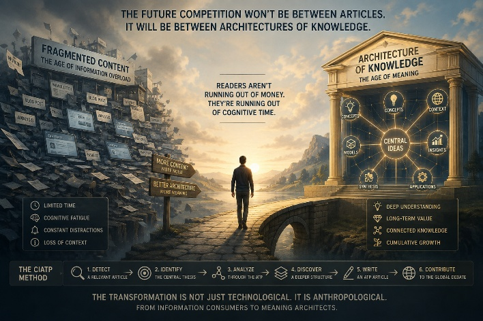
Great historical transformations often begin quietly, appearing first as limited problems within a particular company, industry, technology, or social practice. At the time, those who experience them tend to interpret what is happening through the visible symptoms available to them: declining revenues, changing habits, new competitors, technological disruption, or the apparent exhaustion of a business model. Only later, once the transformation has unfolded across several dimensions of society, does it become possible to recognize that the local crisis was the first visible expression of a much broader civilizational change.
The printing press initially appeared as a more efficient way to reproduce books, yet its deepest effect was to transform the circulation of ideas and the accumulation of knowledge. The Industrial Revolution began with machines capable of producing more quickly and at greater scale, but it eventually reshaped labor, cities, families, politics, education, and the very structure of modern life. The Internet first entered the public imagination as a new communication network, although its long-term consequences have extended far beyond communication and have altered commerce, institutions, social relationships, access to information, and the way societies construct a shared perception of reality.
The current difficulties affecting Substack may belong to this same category of events. The most immediate explanation points toward subscription fatigue, increasing competition between creators, declining paid conversions, and the growing difficulty of sustaining an independent career through recurring reader payments. These are real and measurable problems. They affect writers directly and deserve serious consideration. Yet their importance may extend beyond the economic viability of one platform, because they may also be revealing a more structural transformation in the way knowledge is produced, organized, circulated, and valued.
For centuries, human societies have organized knowledge through relatively stable units. Books, newspapers, academic journals, magazines, blogs, podcasts, newsletters, and videos differ in form, but they share a common architecture: an author or group of authors produces a discrete piece of work, and readers or viewers decide whether to dedicate part of their limited attention to it. Substack inherited this architecture and strengthened the direct relationship between writer and reader by replacing advertising dependence with subscription support. The economic mechanism changed, while the basic intellectual structure remained largely intact.
This model flourished while the number of creators, platforms, and available forms of content remained within limits that readers could still manage. Its current strain may therefore reveal the arrival of a new boundary. Readers today have access to more high-quality writing, analysis, entertainment, education, and specialized knowledge than any previous generation, yet the amount of time and mental attention available to them has not expanded at the same pace. The decisive scarcity of our age is no longer access to information. It is cognitive time.
A reader may possess enough income to support several newsletters, streaming services, newspapers, podcasts, educational platforms, and independent creators. The more difficult problem is finding the time and mental continuity required to engage meaningfully with all of them. Every article now competes not only with other articles, but with work, family life, social networks, videos, podcasts, books, professional obligations, entertainment, and the increasingly rare moments in which a person is able to think without interruption. The economic limit of the subscription model may therefore be only the most visible surface of a much deeper transformation in the relationship between human beings, attention, and knowledge.
From this perspective, the central question changes. The future of independent writing will depend on more than finding a better price, a more effective paywall, a larger audience, or a new subscription bundle. It will depend on understanding what kind of knowledge can earn and retain a lasting place within the finite cognitive time of a reader. That question reaches far beyond Substack, because it concerns the way civilization itself may be entering a new stage in the organization and transmission of thought.
The growing pressure on subscription platforms may therefore be encouraging us to observe only the economic dimension of the problem, while overlooking a transformation that reaches much further. Throughout history, every great advance in the transmission of knowledge has modified not only the mechanisms through which ideas circulated, but also the way civilizations accumulated, organized, and ultimately valued those ideas. If this historical pattern continues to hold, the current discussion about newsletters and subscriptions may eventually be remembered as only the first visible expression of a much deeper change.
For centuries, the principal challenge facing authors was producing knowledge. Today that challenge is gradually being replaced by another: constructing meaning within an environment saturated with information. Every day humanity generates an amount of text, images, videos, research papers, reports, opinions, and commentary that no individual could ever hope to consume during a lifetime. Under these conditions, producing one more article, however well written, is no longer sufficient to guarantee lasting intellectual relevance. The decisive question becomes whether each new contribution helps readers understand reality more deeply or merely adds another layer to an already overwhelming informational landscape.
This distinction may prove decisive for the next stage in the evolution of knowledge. Individual articles undoubtedly continue to possess enormous value. They capture discoveries, observations, experiences, and original arguments that deserve to be shared. Yet an isolated article is naturally constrained by its own boundaries. It begins, develops an argument, reaches a conclusion, and gradually disappears beneath the continuous flow of newer publications. The digital world has dramatically increased our capacity to publish, but it has also accelerated the speed with which each individual contribution is forgotten.
Perhaps the next great intellectual transition will therefore not consist in producing more content, but in constructing coherent architectures of knowledge. An architecture differs fundamentally from a collection of articles because its value does not reside in each individual text considered separately, but in the relationships established between them. Every new contribution strengthens, refines, expands, or occasionally challenges a broader conceptual structure that remains alive through time. Readers no longer return simply because a new article has appeared. They return because each article allows them to deepen their understanding of an intellectual framework that continues evolving while preserving its internal coherence.
From this perspective, the growing difficulties experienced by subscription platforms become easier to understand. The challenge is not merely economic, nor exclusively technological. It concerns the gradual transition from a civilization that primarily consumed information toward one that increasingly seeks systems capable of organizing complexity. Readers overwhelmed by abundance may discover that what they value most is no longer access to another isolated opinion, but access to a coherent way of interpreting reality.
If that interpretation proves correct, the future will not belong exclusively to those who publish more frequently. It may belong instead to those capable of constructing intellectual frameworks that accompany readers for years, allowing each new observation to become part of a larger and continuously developing understanding of the world.